
Restaurant supplies for catering companies: what gets overbought
For catering companies, buying too much of the wrong equipment can quickly inflate restaurant supplies cost and reduce efficiency. From commercial kitchen tools and durable kitchen tools to restaurant supplies for hospitals and restaurants, knowing what truly supports daily operations matters. This guide explores which restaurant supplies for catering companies are most often overbought, how to compare a kitchen tools price list, and what smart buyers should include in a practical restaurant supplies quotation.
In B2B foodservice operations, overbuying rarely comes from careless spending alone. It usually starts with unclear menu planning, inflated safety stock assumptions, or copying another kitchen’s setup without checking production volume, service frequency, labor capacity, and storage space. A catering company serving 200 boxed meals per day needs a very different purchasing plan from one handling 2,000 banquet covers across multiple venues.
This matters even more in today’s kitchen equipment market, where automation, energy efficiency, and digital workflows are shaping buying decisions. Operators, buyers, and business leaders are under pressure to control waste while keeping kitchens compliant, fast, and scalable. The goal is not to buy less at all costs; it is to buy the right restaurant supplies for catering companies at the right quantity, specification, and replacement cycle.
The most commonly overbought restaurant supplies in catering operations
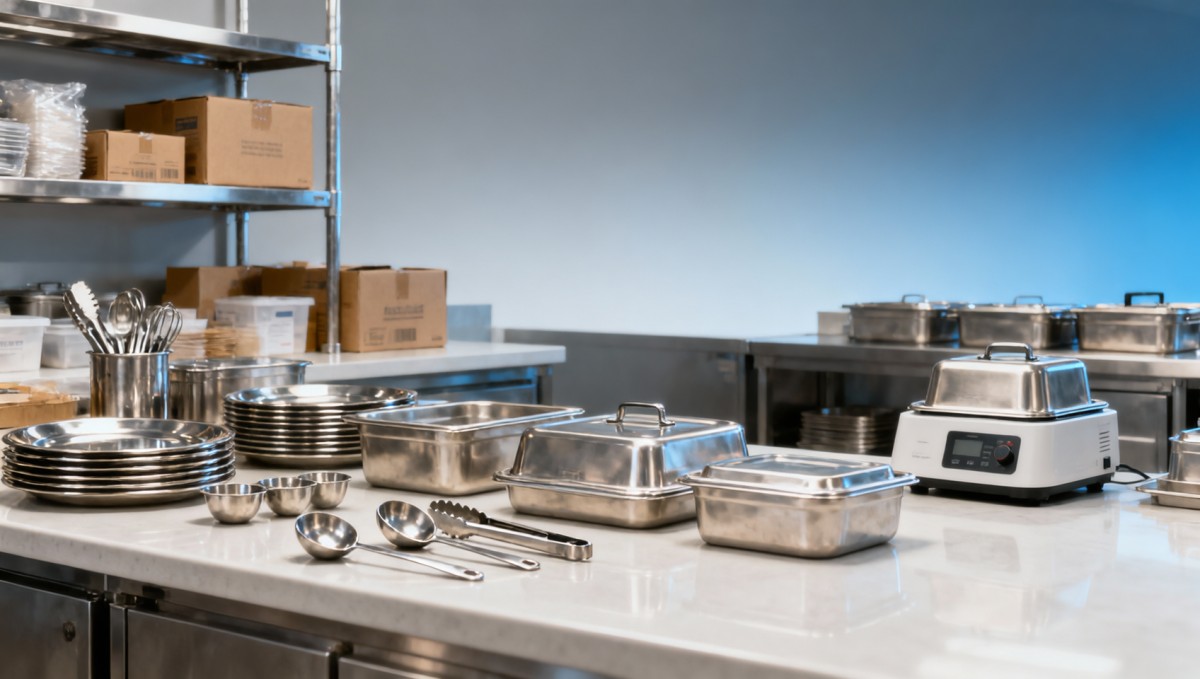
The first category that gets overbought is smallwares. Catering teams often accumulate excessive quantities of tongs, ladles, mixing bowls, hotel pans, serving trays, squeeze bottles, cutting boards, and storage containers. These items are essential, but many companies buy 20% to 40% more than real usage requires because they estimate based on peak events rather than average weekly throughput.
The second category is backup electrical equipment. It is common to see duplicate rice cookers, food warmers, countertop fryers, soup kettles, blenders, or induction units purchased “just in case.” While redundancy is important for high-volume service, too many standby units create storage pressure, idle maintenance work, and unnecessary capital lockup. In many kitchens, one backup per critical process is enough, not three or four.
Disposable service items are another major area of overbuying. Catering firms that serve hospitals, schools, offices, or event venues often overstock takeaway containers, lids, gloves, foil, cling film, napkins, and disposable cutlery. The problem is not only cash flow. Some packaging materials change with menu design, portion size, or local compliance requirements, so holding 3 to 6 months of stock can increase obsolescence risk.
Durable kitchen tools also get overpurchased when procurement teams focus on catalog convenience instead of operational mapping. A buyer may approve a full set of premium chef knives, specialty garnish tools, and plating accessories for every station, even though only 2 or 3 prep zones actually need them. This is especially common when reviewing a kitchen tools price list without linking each item to task frequency.
Why these categories create hidden cost
Overbuying increases more than purchase cost. It affects shelf space, counting labor, cleaning time, breakage exposure, and stock accuracy. If a catering warehouse spends even 15 minutes extra per day searching, rotating, or checking duplicated supplies, that adds up to more than 90 hours per year for one staff member.
It also complicates replacement planning. When too many similar tools are bought from different suppliers over 12 to 18 months, dimensions, material grades, and maintenance needs become inconsistent. That inconsistency slows training and can affect food safety workflows.
The table below summarizes the supplies that catering buyers most often overestimate and the operational reason behind each mistake.
The key takeaway is simple: the most overbought items are not always the most expensive ones. They are the items purchased in large quantities with weak usage discipline. For catering companies, controlling these categories can improve inventory turnover without compromising service readiness.
Why overbuying happens: planning gaps between menus, equipment, and quotations
Many procurement errors start long before a purchase order is issued. A catering operation may request a restaurant supplies quotation based on a broad service concept such as buffet, hospital meal delivery, or corporate lunch service, but fail to define production variables. Without daily meal count, menu cycle length, batch frequency, and transport method, suppliers can only quote a generic list, and buyers often add “extra” items for safety.
A second gap is between menu design and kitchen process. For example, a menu with 12 hot dishes does not always require 12 separate warming units. If production is staggered in 2 or 3 waves and holding time is kept under 45 to 60 minutes, fewer units may be sufficient. The same logic applies to mixers, slicers, and food processors. Capacity planning matters more than raw item count.
Another cause is supplier list inflation. Buyers comparing several kitchen tools price list documents often focus on unit prices but not on duplication across brands or overlapping functions. A heavy-duty planetary mixer and a smaller countertop mixer may both be quoted, even though one can cover 80% of production needs if batch timing is adjusted.
Operational teams also influence overbuying when they ask for restaurant supplies based on convenience rather than process discipline. Staff may want more pans, knives, or containers because it feels faster not to wash, return, or reorganize them during a shift. But adding inventory to compensate for weak workflow usually raises cost faster than it improves output.
Four planning checks before approving a quote
- Confirm average and peak production separately. A buyer should know both the normal daily load and the top 10% event load.
- Map each item to one process step: prep, cook, hold, transport, serve, or clean-down.
- Define replacement cycle by item type. Gloves may be weekly, containers quarterly, and some durable kitchen tools 12 to 24 months.
- Check available storage in cubic terms, not visual estimates. Even 3 to 5 extra shelving units can change stock behavior.
What a practical quotation should include
A strong restaurant supplies quotation should include item description, material or construction, quantity basis, unit price, pack size, lead time, and intended use area. It should also separate core equipment from optional accessories. This helps decision-makers reduce emotional purchasing and compare suppliers on like-for-like terms.
It is also useful to group items into three levels: essential for opening, recommended for scale-up in 3 to 6 months, and optional for niche service formats. That structure can prevent a launch budget from being overloaded by low-rotation supplies.
How to evaluate a kitchen tools price list without buying too much
A kitchen tools price list should never be read as a shopping menu. It is a decision document. The right way to use it is to measure value across durability, task frequency, cleaning time, compatibility, and replacement rate. A lower-priced item that fails every 4 months may cost more over 24 months than a tool priced 20% higher but lasting 18 months.
For catering companies, quantity discipline is as important as price discipline. If a prep team uses 8 chef knives per shift and the breakage or sharpening reserve is 25%, the correct stock target may be 10 units, not 20. Similar calculations apply to GN pans, insulated food carriers, utility carts, and serving utensils.
Material selection matters too. Stainless steel tools for high-frequency use can justify a higher upfront cost, while lower-frequency or non-contact support items may not need premium construction. Overbuying often happens when buyers select the highest specification across the entire list instead of matching each product tier to actual workload.
This is especially relevant in hospital and institutional foodservice. Restaurant supplies for hospitals and restaurants may look similar on paper, but hospital meal systems often require stricter handling consistency, insulated transport discipline, and easier sanitizing surfaces. That means some categories need stronger specifications, while others should be standardized and tightly limited.
Decision factors buyers should score
Before approving any list, many buyers use a 5-point scoring method. Each item can be rated for frequency of use, sanitation importance, breakage risk, storage footprint, and compatibility with current systems. Products scoring high in use frequency but low in storage impact deserve priority; products scoring low in use frequency but high in space consumption need tighter control.
The comparison table below can help procurement teams review a kitchen tools price list with more discipline and fewer duplicate purchases.
The main lesson is that price must be tied to lifecycle and usage rhythm. A disciplined review of the kitchen tools price list often reveals that fewer SKUs, better standardization, and clearer par levels can reduce total supply cost without hurting service resilience.
Smarter purchasing rules for commercial kitchen tools and durable kitchen tools
Commercial kitchen tools should be purchased by production flow, not by catalog category. A catering kitchen usually operates through prep, cooking, holding, packing, transport, and service. Each stage has different quantity logic. Prep tools need higher rotation and wash-back planning, while transport tools need route-based quantity planning tied to delivery schedules and return rates.
Durable kitchen tools should be separated into high-contact essentials and occasional-use accessories. High-contact items include knives, boards, pans, scoops, whisks, thermometers, and storage bins. These deserve standardization, clear labeling, and predictable replacement planning. Occasional accessories such as carving sets, decorative molds, or niche plating tools should usually be purchased only when contracted demand justifies them.
A practical approach is to set par levels by shift count. If a tool is required at 6 stations and wash turnaround is 1 cycle per shift, a par of 1.5x to 2x station need may be enough. If the same tool is difficult to sanitize quickly or travels off-site, the par may rise to 2.5x. Anything beyond that should be supported by actual loss data, not guesswork.
For powered equipment, buyers should ask whether they need redundancy, mobility, or higher capacity. A 10L to 20L mixer may be sufficient for a mid-size central kitchen, while large floor models only make sense if batch consolidation genuinely saves labor. Oversizing equipment often increases energy use, cleaning time, and floor congestion.
A lean purchasing workflow
- List all menu outputs for a 7-day or 14-day cycle.
- Map each output to process equipment and tools.
- Set minimum operating quantity and emergency reserve separately.
- Review breakage, shrinkage, and wash turnaround every 30 to 60 days.
- Adjust future orders using actual issue-and-return records.
When a higher specification is justified
Higher-cost specification is justified when the tool touches food continuously, is exposed to heat or chemicals, or creates a sanitation risk if damaged. It is also justified where dimensional consistency affects portion control, such as ladles, scoops, gastronorm pans, and transport containers. In contrast, over-specification of low-impact accessories usually delivers weak return.
For decision-makers, the best purchasing policy is not “premium everywhere” or “lowest cost everywhere.” It is selective durability where operational pressure is highest, combined with standardized quantities and disciplined reorder points.
How to build a practical restaurant supplies quotation and avoid inventory risk
A useful restaurant supplies quotation should help both procurement and operations. It should not simply list products and prices. Instead, it should show which items support opening readiness, which items are linked to menu volume, and which are optional based on service model. This is particularly important for multi-site caterers and institutional kitchens that have different operating rhythms.
The quotation should also define quantity logic. For example, food pans might be quoted based on active production plus wash reserve, while disposable bowls may be based on 14-day forecast volume and delivery lead time. Without this logic, teams often reorder prematurely or accept inflated starting quantities from habit.
Lead time visibility is another essential factor. Imported or custom-fabricated items may require 3 to 8 weeks, while standard consumables may ship in 3 to 7 days. Mixing both into one undifferentiated buying plan creates two risks at the same time: overstock of fast items and shortage of slow items.
For business leaders, the quotation should support phased investment. A catering company expanding from 1 kitchen to 3 satellite distribution points should not buy every projected supply need on day one. A 3-stage plan often works better: opening package, stabilization package after 60 to 90 days, and expansion package after demand proves stable.
Recommended quotation structure
The table below shows a practical structure that helps reduce overbuying while still protecting service continuity.
A quotation built this way gives operators a usable roadmap, buyers a measurable review tool, and decision-makers a phased investment model. It turns restaurant supplies procurement from a reactive purchasing task into a controlled operational system.
FAQ: selection, delivery, and control points for catering buyers
How can a catering company know if it is overbuying?
A simple warning sign is when more than 15% to 20% of smallwares and consumables remain untouched across a full 30-day operating cycle. Another sign is repeated storage overflow, duplicate SKUs, or tools being opened from new cartons before older stock is used. Monthly issue records and shelf counts usually reveal these patterns quickly.
What restaurant supplies for hospitals and restaurants need stricter control?
Items tied to sanitation and portion consistency need the strictest control. These include food-grade storage bins, insulated carriers, thermometers, cutting boards, serving ladles, gloves, and temperature holding equipment. In healthcare settings, standardization is often more valuable than variety because it reduces handling errors and simplifies cleaning routines.
What is a reasonable stock horizon for disposable supplies?
For many catering businesses, 14 to 30 days is a practical working horizon for common packaging and disposables, assuming stable supplier lead times. Extending to 45 days may make sense for high-volume predictable contracts. Going beyond 60 to 90 days usually requires strong justification such as seasonal access constraints or import lead times.
How often should buyers review a kitchen tools price list?
A formal review every 6 to 12 months is typical, but fast-moving categories should be checked every quarter. The purpose is not only to compare prices. Buyers should also review whether the item still fits current menu output, labor patterns, and maintenance practices.
For catering companies, the biggest purchasing mistake is not always buying expensive equipment. It is buying the wrong quantity, the wrong specification, or the wrong mix of restaurant supplies for catering companies without a clear link to menu volume and workflow. Better control starts with realistic usage mapping, disciplined comparison of a kitchen tools price list, and a restaurant supplies quotation built around quantity logic, lead time, and phased demand.
If you are reviewing commercial kitchen tools, durable kitchen tools, or supply plans for institutional and event catering, a structured assessment can reduce waste, improve storage efficiency, and support more reliable service. Contact us to get a tailored restaurant supplies quotation, discuss product details, or explore a practical supply strategy for your kitchen operation.
- central kitchen
- kitchen tools
- restaurant supplies
- Slicer
- Mixer
- Food Processor
- Planetary Mixer
- Food Warmer
- kitchen equipment
- restaurant supplies for catering
- restaurant supplies quotation
- restaurant supplies for hospitals
- restaurant supplies cost
- restaurant supplies for catering companies
- commercial kitchen tools
- durable kitchen tools
- kitchen tools price list
Popular Tags
Kitchen Industry Research Team
Dedicated to analyzing emerging trends and technological shifts in the global hospitality and foodservice infrastructure sector.
Industry Insights
Join 15,000+ industry professionals. Get the latest market trends and tech news delivered weekly.
No spam. Unsubscribe anytime.


Contact With us
Contact:
Anne Yin (Ceramics Dinnerware/Glassware)
Lucky Zhai(Flatware)