
Kitchen Tools Factory Certifications: ISO 9001 Alone Doesn’t Guarantee Batch Consistency
When sourcing kitchen tools for hospitals, schools, hotels, or professional chefs, buyers often assume ISO 9001 certification guarantees consistent quality across batches — but it doesn’t. A kitchen tools factory may be ISO 9001-compliant while still delivering variable performance in durability, ergonomics, or ease of cleaning. For kitchen tools distributors, OEM partners, and procurement teams placing bulk orders or wholesale kitchen tools, understanding the gap between certification and real-world consistency is critical — especially when supplying high-quality, eco-friendly, space-saving, or easy-to-clean kitchen tools for catering, baking, small spaces, or home use.
Why ISO 9001 Alone Fails to Ensure Batch-to-Batch Consistency
ISO 9001 certifies a factory’s quality management system — not its output. It validates documented processes for planning, monitoring, and corrective action, but does not mandate material traceability, dimensional tolerance controls, or batch-level validation testing. In practice, a certified facility may shift raw material suppliers mid-production run, adjust heat-treatment parameters without requalification, or skip post-forging hardness checks on 30% of units — all while remaining fully compliant.
Kitchen tools — particularly forged stainless steel knives, tongs, ladles, and baking scrapers — require tight tolerances (±0.3mm on blade thickness, ±1.5° on ergonomic handle angles) and repeatable metallurgical outcomes (e.g., Rockwell hardness HRC 54–58). These depend on process stability, not just procedural documentation. Without additional controls, ISO 9001 leaves room for ±8–12% variation in edge retention, grip fatigue resistance, or dishwasher-safe cycle endurance across consecutive production lots.
This matters most for high-volume users: central kitchens serving 5,000+ meals daily, hospital catering units with strict infection control protocols, or bakery OEMs requiring tool interchangeability across 3+ manufacturing sites. A single inconsistent batch can trigger retraining, workflow disruption, or non-conformance reports — costing $2,000–$7,000 in labor and downtime per incident.
Key Gaps Between Certification and Real-World Performance
- Material Traceability: ISO 9001 doesn’t require lot-specific mill test reports or stainless grade verification (e.g., 304 vs. 201) for each shipment — yet substandard alloy causes premature pitting and discoloration after 150+ dishwasher cycles.
- Process Validation: Heat treatment, polishing, and coating steps are rarely audited for repeatability; variance in tempering time (±90 seconds) shifts hardness by up to 6 HRC points.
- Sampling Rigor: Standard AQL Level II sampling allows up to 2.5% defect rate — unacceptable for surgical-grade cutting tools used in food prep zones.
What Procurement Teams Should Verify Beyond ISO 9001
For mission-critical kitchen tools, procurement must layer ISO 9001 with operational evidence. Leading suppliers supplement certification with three verifiable practices: First, full batch traceability — including heat number logs, raw material certificates, and in-process inspection records tied to every carton. Second, statistical process control (SPC) charts for critical dimensions and surface finish, reviewed weekly. Third, third-party batch validation: random sampling tested at accredited labs for corrosion resistance (ASTM A262 Practice E), edge retention (DIN 51130 slip resistance), and dishwasher durability (IEC 60350-1, 100-cycle test).
Procurement checklists should include minimum requirements across five core dimensions: material compliance (EN 10088-1 for stainless grades), dimensional tolerance (±0.25mm on critical features), surface roughness (Ra ≤ 0.8μm for food-contact surfaces), batch labeling (heat number + production date + inspector ID), and validation report availability within 48 hours of shipment notice.
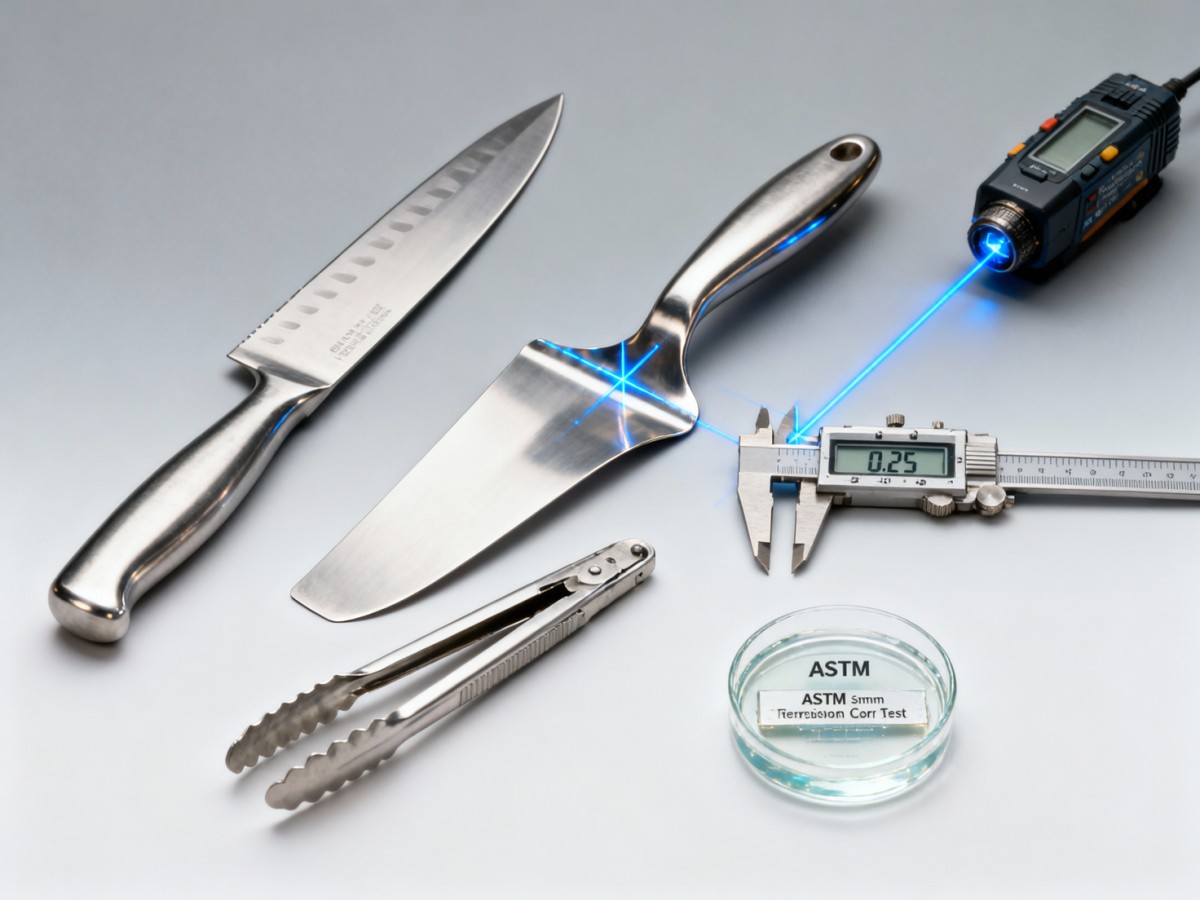
This table reveals why relying solely on ISO 9001 creates blind spots. For example, a supplier claiming “full compliance” may conduct corrosion testing only once per quarter — insufficient to catch alloy substitution or passivation failure in a single batch. Requiring ASTM A262 testing per 200 kg ensures early detection before tools reach end-users.
How Smart Buyers Evaluate Consistency Across Suppliers
Top-tier procurement teams apply a 4-step consistency assessment: (1) Request batch-level validation reports from the last three shipments; (2) Conduct side-by-side comparison of 3 randomly selected units from different batches on hardness, weight variance (<±0.8%), and surface finish uniformity; (3) Audit SPC data for 3 consecutive weeks — rejecting suppliers with >2 out-of-control points; (4) Require pre-shipment samples signed off by both factory QA and an independent lab.
Time-to-result matters: leading factories deliver validation reports within 24–48 hours of batch completion. Slower turnaround (>5 days) correlates strongly with reactive — not proactive — quality culture. Also watch for red flags: missing heat numbers on packaging, mismatched lot codes between documents and physical labels, or inability to reproduce a prior batch’s exact finish under identical specs.
Real consistency also means adaptability: the best factories maintain stable output even during raw material shortages — using dual-sourced alloys with identical mechanical properties and validated alternative forging parameters. This prevents forced redesigns or delayed deliveries when global supply chains tighten.
Why Partner With Us for Consistent, Compliant Kitchen Tools
We combine ISO 9001:2015 certification with ISO 22000:2018 (food safety), EN 10204 3.1 material certification, and proprietary batch validation protocols. Every order includes heat-number-traced mill reports, SPC charts for critical dimensions, and ASTM-tested validation data — delivered digitally within 24 hours of batch release.
Our standard lead time is 18–22 days for custom kitchen tools (vs. industry average of 30–45 days), with rush options down to 10 working days — backed by dual-material sourcing and in-house metrology labs. We support OEMs with full documentation packages for FDA, EFSA, and JIS compliance, plus sample kits with cross-batch comparison data for your internal QA team.
Contact us to request: (1) recent batch validation reports for your target product line, (2) dimensional tolerance benchmarks for your application (e.g., ergonomic grip radius for left-handed chefs), or (3) a customized checklist aligned with your internal quality gate requirements.
Popular Tags
Kitchen Industry Research Team
Dedicated to analyzing emerging trends and technological shifts in the global hospitality and foodservice infrastructure sector.
Industry Insights
Join 15,000+ industry professionals. Get the latest market trends and tech news delivered weekly.
No spam. Unsubscribe anytime.

Contact With us
Contact:
Anne Yin (Ceramics Dinnerware/Glassware)
Lucky Zhai(Flatware)