
Restaurant Supplies Cost Breakdown: What Buyers Should Budget For
A restaurant purchase order can look reassuringly simple: a range, a refrigerator, a prep table, a dishwasher, a few racks of cookware, and dining-room essentials. Then the project moves from quotation to opening day, and the overlooked charges begin to surface. Delivery access is restricted. A hood requires additional fire-suppression work. The ice machine needs a water treatment system. The chosen plates do not fit the dish racks. A low-cost freezer consumes more electricity than expected.
That is why restaurant supplies cost should be viewed as a budget for an operating system, not merely a list of products. For procurement teams, the goal is to balance opening capital, food safety, production capacity, staff workflow, utility use, and the inevitable cost of replacement. The right budget is not necessarily the lowest one; it is the one that allows the operation to serve consistently without creating expensive bottlenecks later.
Start with the operating model, not the catalog
Before assigning numbers to equipment categories, define what the kitchen must actually do. A quick-service outlet, a hotel banquet kitchen, a bakery, a delivery-focused virtual brand, and a full-service restaurant may all purchase “commercial kitchen equipment,” but their cost profiles are very different.
Procurement should ask a practical set of questions early: How many covers or orders are expected during the peak hour? Which menu items drive the most volume? Will ingredients arrive fresh, frozen, or partially prepared? Is production handled on site, in a central kitchen, or through a food processing partner? How much storage is needed between deliveries? The answers shape sizing decisions for refrigeration, cooking lines, worktables, dishwashing, and smallwares.
A common budgeting error is to select equipment by footprint or initial purchase price alone. A compact fryer may fit the plan, for example, but fail during peak demand. Conversely, buying oversized equipment “just in case” can tie up capital, increase utility costs, and consume valuable work space. Capacity should be based on realistic throughput, menu complexity, and planned growth—not the most optimistic sales forecast.
The major restaurant supplies cost categories
While every project is different, a reliable budget separates purchases into groups that behave differently over time. Large appliances are visible and easy to price. The more fragmented categories deserve equal attention because they often create the last-minute spend.
Cooking and hot-line equipment
This category may include ranges, ovens, combi ovens, grills, griddles, fryers, steamers, microwaves, warming cabinets, and holding equipment. Cost varies according to fuel type, output, controls, construction, ventilation needs, and whether the unit is designed for continuous heavy-duty use.
For buyers comparing options, the important question is not simply “gas or electric?” It is whether the selected unit matches site utilities, the menu, staff skills, and anticipated service pattern. Intelligent cooking equipment with programmable settings can improve repeatability where labor turnover is high, but it may carry a higher upfront price and require training. In a simple, stable menu operation, robust manual controls can sometimes offer the better lifecycle value.
Refrigeration, freezing, and cold storage
Refrigerated prep counters, reach-in refrigerators, walk-in rooms, undercounter cabinets, blast chillers, freezers, and ice makers form a major part of both capital cost and ongoing energy spend. Cold equipment should be evaluated as a system: storage capacity, door openings, ambient heat, product loading patterns, condenser access, drainage, and cleaning routines all affect performance.
A cheaper refrigerator that struggles in a hot kitchen can put inventory and food safety at risk. Buyers should also check usable internal capacity rather than relying only on external dimensions. Shelf configuration, pan compatibility, and clear access for stock rotation matter every day to the team using the equipment.
Preparation equipment and food processing machinery
Prep budgets can range from basic hand tools and stainless-steel tables to mixers, slicers, vacuum packers, dough equipment, vegetable processors, meat grinders, and automated portioning systems. These purchases should follow a labor-and-volume assessment. A machine may appear expensive on a unit-price basis, yet be sensible if it removes repetitive manual work, improves portion control, or supports a central kitchen producing for several outlets.
At the same time, automation is not an automatic win. Consider cleaning time, blade or attachment replacement, safe operation, spare-part availability, and whether the machine will be used frequently enough to justify its space and maintenance needs.
Warewashing, hygiene, and safety supplies
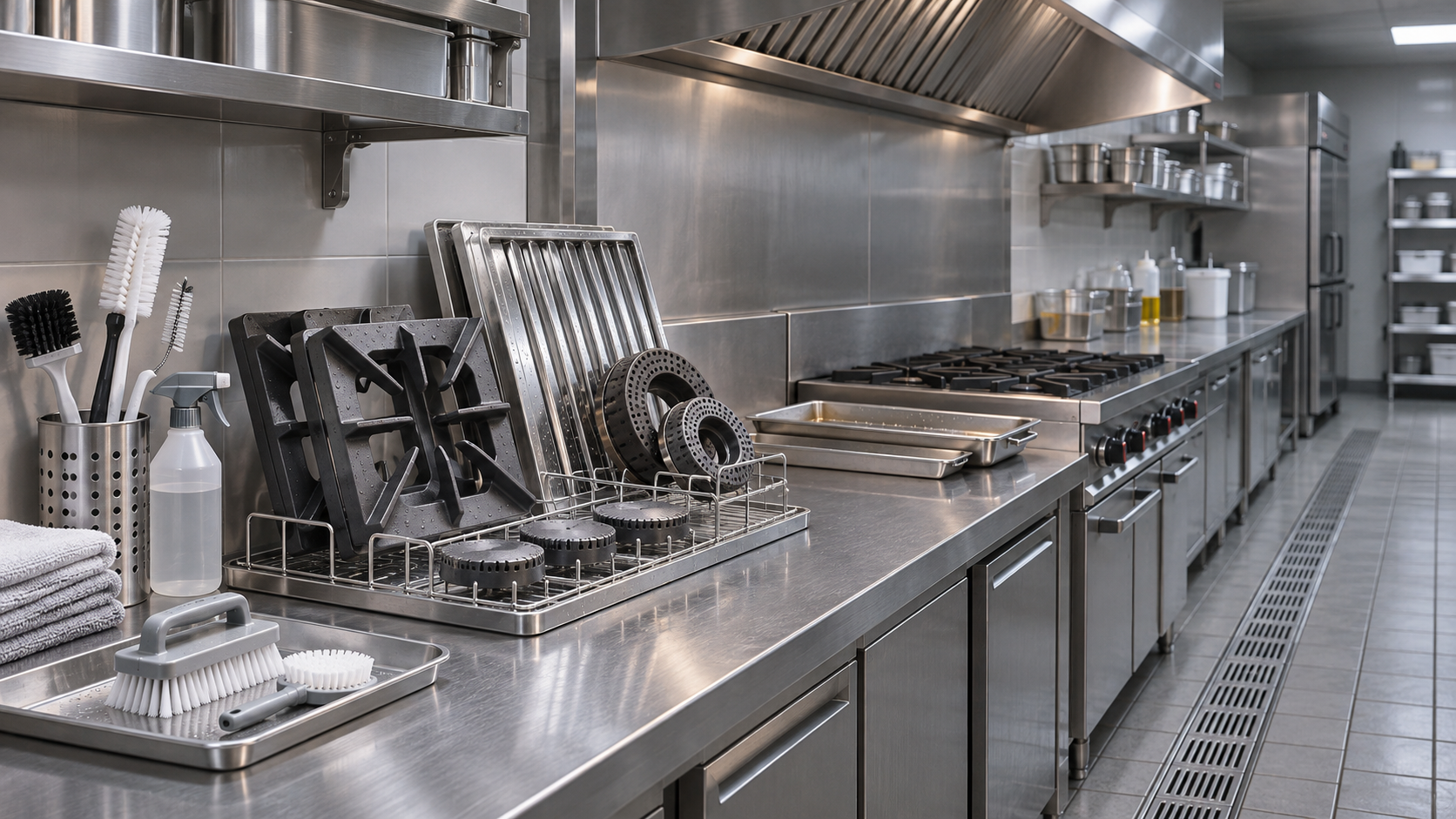
Dishwashers, glasswashers, sinks, handwashing stations, grease-management components, chemical dispensers, storage racks, cleaning tools, and personal protective equipment are sometimes budgeted too late. Yet they are essential to sanitation, labor flow, and regulatory compliance.
Warewashing costs extend beyond the machine. Water supply, drainage, water hardness, detergent systems, exhaust or heat recovery requirements, racks, and replacement glassware all need consideration. A dishwasher that runs quickly but requires extensive pre-rinsing may not deliver the labor saving expected. In regions with hard water, treatment equipment can be a necessary protection for heating elements and wash results rather than an optional add-on.
Smallwares, utensils, and front-of-house items
Pots, pans, knives, cutting boards, gastronorm pans, containers, measuring tools, thermometers, trays, servingware, glassware, tableware, and bar tools often arrive as dozens of small line items. Because each item is comparatively inexpensive, this category can be underestimated until ordering begins.
Build the smallwares list station by station: receiving, storage, cold prep, hot prep, pastry, cooking line, pass, dish area, bar, and dining room. Include backup quantities for high-breakage or high-turnover items. It is also wise to standardize dimensions where possible. Compatible food pans, lids, racks, and storage containers reduce clutter and make replacement purchasing simpler.
What the quotation often does not include
Equipment pricing is only one layer of restaurant supplies cost. Procurement teams should create a separate “project enablement” line in the budget rather than treating these expenses as contingencies hidden in a general allowance.
- Freight, unloading, and placement: Heavy equipment may require tail-lift delivery, pallet handling, stair access, lifting equipment, or restricted-hour delivery coordination.
- Installation and commissioning: Connections for gas, electric, water, drainage, ventilation, and controls can require licensed contractors. Startup checks are especially important for refrigeration, dishwashing, and programmed equipment.
- Ventilation and fire protection: Hoods, ducting, make-up air, filtration, fire suppression, and inspections can significantly affect the total project cost.
- Utility upgrades: Electrical load, gas capacity, water pressure, floor drains, and grease systems may need alteration before equipment can operate as intended.
- Compliance and documentation: Local health, fire, building, electrical, and accessibility requirements can influence product selection and installation scope.
- Training: Staff must know how to use, clean, calibrate, and safely shut down equipment. Without this, advanced features may go unused and warranties may be compromised.
Ask suppliers to state clearly what is included, excluded, and assumed. A quotation that looks more expensive may actually cover delivery, commissioning, or accessories that another offer leaves to the buyer. Comparing line totals without matching scope is one of the fastest ways to make a misleading procurement decision.
Budget for ownership, not just acquisition
Total cost of ownership is particularly relevant in commercial kitchens because appliances operate under heat, moisture, grease, frequent cleaning, and intense peak-hour use. A meaningful comparison includes purchase cost, installation, energy and water consumption, consumables, planned maintenance, repair exposure, downtime risk, and expected service life.
Energy-efficient kitchen solutions deserve a measured review. High-efficiency refrigeration, induction cooking, insulated holding equipment, and water-conscious warewashing can reduce operating costs, but the payback depends on local utility rates, operating hours, and kitchen habits. Buyers should request energy-use information in a comparable format and avoid assumptions based solely on product labels or marketing language.
Serviceability is equally important. Check whether qualified service technicians cover the operating location, whether critical spare parts are locally available, and how long common repairs typically take. A low-priced imported unit may be appropriate for noncritical use, but a failed primary refrigerator or combi oven can interrupt service and create inventory losses. For critical equipment, resilience has economic value.
Where to spend more—and where to control the budget
Not every item deserves the same investment level. A useful approach is to classify purchases by operational criticality. Spend more carefully on equipment that affects food safety, production continuity, energy use, or the signature menu. Refrigeration, ventilation-related equipment, core cooking units, and warewashing systems commonly fall into this group.
Budget discipline is often easier with items that are standardized, easy to replace, or not central to the customer experience. Generic shelving, some storage containers, basic utensils, and non-specialized worktables may offer room for value sourcing, provided materials, load ratings, hygiene requirements, and fit are acceptable.
There is a middle ground for items such as tableware, cookware, knives, and serving pieces. The decision should reflect expected use, breakage rate, brand presentation, and replacement availability. An unusual plate design may look distinctive at launch but become a purchasing headache if it is discontinued six months later. For multi-site operators, standardization can create meaningful savings in replenishment and staff familiarity.
A practical procurement sequence
Strong purchasing decisions rarely come from collecting the largest number of quotes. They come from locking down the information that makes quotes comparable. Start with a room-by-room equipment schedule linked to the menu, layout, utility plan, and expected production volume. Then separate “must open with” purchases from items that can be phased in after demand is proven.
For each significant item, document required capacity, dimensions, power or fuel connection, accessories, warranty, lead time, cleaning needs, installation responsibility, and service contact. This creates a useful comparison matrix and reduces the risk of missing an ice bin, a stand, a water filter, a conversion kit, or a required rack system.
Lead times deserve special attention in an international supply environment. Kitchen equipment may be sourced from manufacturing centers in China, Germany, Italy, Japan, and other markets, with each choice affecting freight, documentation, voltage compatibility, spare parts, and after-sales support. Imported products can be a strong fit, but buyers should confirm specifications for the destination market before placing the order—not after the equipment reaches the site.
Common cost traps before opening day
Several problems recur across restaurant projects. The first is buying equipment before the final layout and utility drawings are confirmed. The second is forgetting that dimensions include door swing, ventilation clearance, and service access—not just the cabinet width. The third is underordering consumables and replacements: filters, chemicals, seals, pans, racks, bulbs, temperature probes, and spare utensils all support daily operation.
Another trap is placing every cost-saving decision on the opening budget. A restaurant has to operate after opening. Deferring nonessential decor may be reasonable; deferring a safe handwash station, adequate cold storage, or basic maintenance support is usually false economy.
Turn the budget into a working purchasing plan
A well-managed restaurant supplies cost plan is a living document. Update it as the menu changes, supplier offers are clarified, construction conditions are confirmed, and lead times move. Keep capital equipment, installation, initial consumables, operating spares, and contingency visible as separate lines. That clarity helps finance teams understand the full commitment and helps operations teams avoid unpleasant surprises.
Ultimately, the best procurement outcome is a kitchen where equipment fits the workflow, supplies are easy to replenish, utilities are used responsibly, and staff can maintain consistent standards under pressure. When buyers budget for the full operating picture—not only the purchase order—they protect both the opening schedule and the long-term economics of the foodservice business.
Popular Tags
Kitchen Industry Research Team
Dedicated to analyzing emerging trends and technological shifts in the global hospitality and foodservice infrastructure sector.
Industry Insights
Join 15,000+ industry professionals. Get the latest market trends and tech news delivered weekly.
No spam. Unsubscribe anytime.


Contact With us
Contact:
Anne Yin (Ceramics Dinnerware/Glassware)
Lucky Zhai(Flatware)