
How to Size a Planetary Mixer Machine for High-Viscosity Batch Production
Bowl capacity is a poor starting point for sizing a planetary mixer machine used with heavy doughs, dense fillings, nut pastes, confectionery masses, or high-solids creams. A mixer can physically hold a batch yet still fail to develop the required product because its available torque, tool geometry, speed range, or thermal margin is inadequate. Conversely, an oversized machine may mix a small batch poorly because the agitator cannot engage enough material.
The useful sizing question is therefore not “What bowl volume is needed?” but “What resistance will the mixer see across the full batch cycle, and can it sustain that load while delivering the required shear, folding, and incorporation?” The answer depends on formulation, batch mass, fill level, processing temperature, mixing tool, and the point in the recipe at which resistance peaks.
Begin with the product’s worst mixing condition
High viscosity is not a single, stable property. Many products change substantially during a batch. A cream may be relatively fluid during initial charging but become much stiffer after fat crystallization or powder addition. A dough may have its highest load after hydration, when gluten development increases resistance. A filling containing sugar, starch, protein, particulates, or reduced moisture can show a sharp torque rise late in the cycle.
Machine selection should be based on this peak-load condition, not on the easiest stage of mixing. A formulation sheet should identify at least:
- total batch mass and expected batch volume;
- ingredient addition sequence;
- product temperature at charging and discharge;
- target final temperature;
- minimum and maximum solids content;
- particle size and abrasive or fibrous ingredients;
- required mixing time, speed changes, and rest periods;
- the mixing tool used at each stage; and
- the stage where the product becomes most resistant.
This information is more valuable than a viscosity value stated without test conditions. Viscosity measurements depend on temperature, shear rate, instrument geometry, and sample history. Products such as dough, whipped compounds, emulsions, and suspensions may be non-Newtonian: their apparent viscosity changes as the tool speed changes. Some materials also have a yield stress, meaning that the agitator must apply a minimum force before the mass begins to move properly.
Where laboratory rheology data are available, they can support comparison among formulations. They do not replace a production-representative mixing trial. The material behavior inside a rotating planetary bowl is affected by wall contact, tool clearance, ingredient distribution, and the evolving structure of the batch.
Convert batch requirement into usable bowl loading
Bowl volume must be calculated from product density, but the resulting figure is only the geometric minimum. The fundamental relationship is:
Required product volume = batch mass ÷ bulk density
A 60 kg batch does not occupy the same volume when it is a dense sugar paste, a hydrated dough, or a low-density aerated cream. Bulk density should be measured for the actual production condition, including entrained air where relevant. Using ingredient density rather than finished-mass bulk density can create a misleading capacity estimate.
After calculating product volume, reserve headspace for circulation, expansion, ingredient additions, and tool movement. Heavy materials generally need sufficient room to turn over and fold rather than being compressed against the bowl wall. Aerated products need additional space because their volume can increase significantly during mixing. Powders added into a moving batch may require space to prevent spillover and uncontrolled dust release.
At the same time, a bowl should not be selected only for maximum headspace. A very small batch in a large bowl can sit below the effective sweep zone of the beater, hook, or paddle. The tool may pass through the product without creating enough bulk movement, leaving unmixed material near the base or sidewall. This is especially relevant where one mixer is expected to make both full-scale production batches and much smaller development or seasonal batches.
A sound evaluation defines a normal operating range rather than one nominal batch size. The lower end matters as much as the upper end. Suppliers should be asked to state the minimum recommended batch for each tool and application, not merely the bowl’s rated capacity.
Rated motor power is not the same as mixing capacity
Motor kilowatts are often treated as a shortcut for machine strength, but they do not by themselves indicate whether a planetary mixer can process a particular heavy formulation. The relevant output is torque available at the agitator under the intended operating speed, together with the ability of the transmission, shafts, bearings, and overload protection to withstand repeated peak loads.
Power is the product of torque and rotational speed. A mixer may show a relatively high motor rating yet provide insufficient low-speed torque for a dense mass if the drive arrangement is not designed for that duty. Conversely, a machine with an appropriate reduction system may deliver strong low-speed torque without appearing exceptional in motor power alone.
For high-resistance applications, the technical assessment should request:
- continuous-duty and short-duration torque information, if provided by the manufacturer;
- the permitted operating speed for the proposed tool and product;
- drive type, reduction arrangement, and overload protection method;
- maximum allowable batch mass by product category, not just bowl size;
- motor duty classification and thermal protection provisions;
- limits on consecutive heavy batches and required recovery intervals; and
- evidence from a trial using a comparable formulation and batch size.
A useful discussion with a supplier is not “Can this machine mix 80 kg?” It is “Can it mix an 80 kg batch with this density, this tool, this temperature profile, this addition sequence, and this cycle time?” Those conditions determine the mechanical load.
It is also important to distinguish a momentary startup surge from sustained torque demand. A heavy batch can impose high load for much of the cycle, particularly where the product clings to the tool and bowl wall or where a dough hook must continuously stretch and fold a developed mass. Repeated operation near a machine’s limiting load raises the risk of overheating, drive wear, nuisance trips, inconsistent mixing, and shortened component life even when each individual batch appears to complete.
Tool selection changes the machine requirement
The same bowl and drive may be suitable for one product and unsuitable for another because planetary mixing tools create different flow patterns. The tool must be assessed as part of the sizing calculation rather than treated as an accessory selected after the mixer has been chosen.
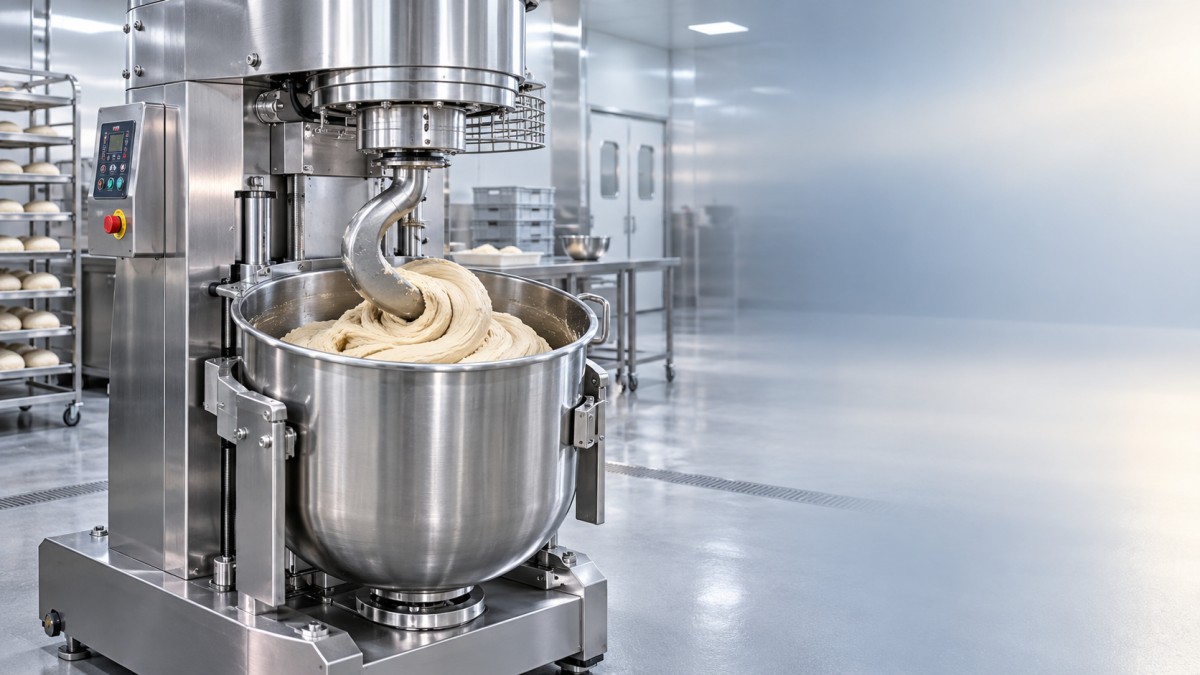
A dough hook concentrates force into a smaller working zone and is intended to pull, stretch, and fold cohesive dough. It can impose substantial torque demand, especially with low-hydration doughs or formulations containing high protein flour. A flat beater or paddle creates broader sweeping and shearing action, often suitable for batters, fillings, mashed products, and dense blends. A wire whip is designed for aeration and is generally not the primary tool for high-viscosity production, even though a product may later pass through an aeration stage.
Tool diameter, shape, clearance to the bowl, and planetary path influence how effectively material is picked up from the bottom and wall. Excessive clearance can leave dead zones. Insufficient clearance can increase friction, product smearing, and the consequences of bowl or tool deflection under load. For particulate formulations, tool geometry must also allow ingredients to circulate without breakage or jamming.
Some processes need more than one tool within a single batch. For example, ingredients may be initially blended with a paddle and then developed with a hook. Sizing should reflect the highest load tool and the transition point between tools. If tool changes are expected, the practical consequences matter: sanitation time, operator handling, tool storage, lifting requirements, and the risk of using the wrong tool for a programmed recipe.
Speed control should match the process, not maximize rpm
Higher agitator speed does not automatically improve heavy-product mixing. At high resistance, excessive speed can raise frictional heat, strain the drive, pull material upward on the tool, or cause the batch to ride around the bowl rather than turn over. In dough production, an inappropriate speed profile can alter development and final temperature. In fat-based or temperature-sensitive fillings, frictional heat may soften the product or disturb the desired structure.
The needed control range depends on the process. Low speed is often required for charging dry ingredients, wetting powders, and starting a heavy mass without a torque spike. A controlled intermediate speed may be needed for uniform blending. Higher speed may be appropriate only for a defined finishing step where the product remains within the machine’s permitted load envelope.
Variable-frequency control can provide useful speed adjustment, but it should not be assumed to create unlimited low-speed capability. The drive, motor cooling arrangement, gearbox, and control parameters must be designed to maintain usable torque and thermal performance over the intended speed range. A proposed speed schedule should be reviewed alongside batch duration and temperature rise, rather than as a separate control feature.
Thermal load is a sizing issue, not only a product-quality issue
Mechanical energy introduced by mixing becomes heat. With high-viscosity material, the heat generated by friction can be significant enough to affect both product quality and equipment duty. The temperature rise may be influenced by the starting temperature of ingredients, bowl material, ambient conditions, tool speed, batch duration, and the product’s resistance to flow.
For temperature-sensitive recipes, define an acceptable final-temperature window and measure it during a representative trial. If the process needs cooling, determine whether cooling is provided upstream through ingredient conditioning, through a jacketed bowl or external system, or through shorter and staged mixing cycles. A standard planetary mixer bowl is not automatically a thermal-control vessel. Assuming otherwise can lead to a process that works for one batch but becomes unstable during repeated production.
Thermal evaluation should also consider the machine itself. Heavy production may involve several batches in succession. Motor and gearbox temperatures can accumulate over the shift. If the supplier’s application rating assumes intermittent operation, the planned production schedule may exceed the intended duty even when a single batch is within capacity.
Check the actual process around the mixer
A correctly sized planetary mixer machine can still become the weak point of a batch line if charging and discharge are poorly matched to its design. High-viscosity products do not always discharge cleanly under gravity. Bowl lifting, tilting, scraping, removable bowls, and transfer vessels need to be evaluated against the product’s adhesion and the downstream process.
For a heavy filling or paste, retained product on the tool, bowl wall, and base can represent both yield loss and a sanitation burden. For allergen-controlled production, the design should permit effective access to product-contact surfaces and avoid hard-to-clean cavities around attachments, guards, and bowl supports. If the mixer will handle multiple recipes, the cleaning method and changeover time may influence the preferred bowl size and attachment configuration.
Facility conditions also affect selection. A large floor mixer may require defined clearance for bowl removal, tool handling, service access, and safe loading. Electrical supply must match the motor and control system. The floor or platform must support the equipment and the maximum filled-bowl weight without vibration problems. Where flour or other fine powders are used, ingredient handling and dust-control practices should be considered as part of the installation, not after the mixer is commissioned.
Use trials to validate the load envelope
For demanding formulations, a supplier demonstration using water or a light batter has limited value. The most reliable assessment uses the actual formulation or a technically justified equivalent that matches density, solids, temperature, and peak resistance. The trial should cover the complete cycle: charging, low-speed incorporation, high-load mixing stage, any speed transition, discharge, and cleaning access.
Acceptance should not be based solely on whether the machine completes the cycle. Record batch uniformity, temperature change, visible unmixed zones, time to reach the desired texture, motor load indication where available, vibration, bowl movement, tool clearance, and ease of discharge. Repeatability across more than one cycle is important when the product is close to the mixer’s upper working limit.
If the intended formulation is still under development, selection should be conservative. A machine sized exactly to an early recipe can become inadequate after modest changes in hydration, solids, ingredient source, particulate level, or batch temperature. The appropriate margin is not a universal percentage; it should be justified by the expected formulation range and the manufacturer’s stated application limits.
Where a planetary mixer reaches its practical limit
Planetary mixers are versatile, but they are not the right solution for every high-viscosity batch. Extremely stiff, low-moisture, highly cohesive, or continuously produced materials may require a different mixing principle, such as a spiral, horizontal, double-arm, sigma-blade, or other heavy-duty mixer designed around the product’s rheology. The decision should follow the required result, not familiarity with a machine category.
A planetary design remains a strong option where the process benefits from interchangeable tools, batch flexibility, broad recipe coverage, and accessible bowl handling. It becomes less suitable when the product consistently demands near-limit torque, requires highly controlled kneading action, or cannot be discharged and cleaned efficiently from a planetary bowl.
The final specification should state the product range, usable batch range, proposed tools, speed schedule, maximum temperature rise, duty cycle, and trial acceptance conditions. That converts a nominal capacity purchase into an application-defined decision—and reduces the risk that a mixer selected for its bowl size becomes undersized where it matters most: under the highest-resistance part of the batch.
Popular Tags
Kitchen Industry Research Team
Dedicated to analyzing emerging trends and technological shifts in the global hospitality and foodservice infrastructure sector.
Industry Insights
Join 15,000+ industry professionals. Get the latest market trends and tech news delivered weekly.
No spam. Unsubscribe anytime.

Contact With us
Contact:
Anne Yin (Ceramics Dinnerware/Glassware)
Lucky Zhai(Flatware)