
How to Select Restaurant Kitchen Tools for Faster Prep, Safer Handling, and Long Service Life
How to Select Restaurant Kitchen Tools for Faster Prep, Safer Handling, and Long Service Life
Selecting the right kitchen tools for restaurants is a purchasing decision that directly affects prep speed, food safety, labor efficiency, and long-term operating costs. For procurement teams, durable materials, ergonomic design, sanitation compliance, and compatibility with high-volume workflows are essential factors. This guide explains how to evaluate restaurant kitchen tools that support safer handling, faster preparation, and reliable performance throughout their service life.
The mistake is to treat utensils as minor purchases because their unit prices are lower than ovens, refrigeration systems, or food-processing machinery. A poorly chosen knife, tong, scoop, cutting board, pan, container, or measuring tool can slow an entire prep line. It can also create avoidable waste, increase hand injuries, complicate cleaning, and force frequent replacement. In busy kitchens, small tool failures are rarely isolated; they disrupt timing, portion control, and staff routines.
The most useful purchasing approach starts with the work, not the catalog. A central kitchen producing thousands of portions each day needs a different tool mix from a compact restaurant kitchen preparing made-to-order dishes. Hotels may prioritize versatility across banquet, buffet, and à la carte operations. Food processing facilities may need greater consistency, traceability, and separation between raw and ready-to-eat food areas. The right choice depends on how tools move through the actual workflow.
Map the Prep Process Before Comparing Products
Before requesting quotations, identify where preparation time is being lost. It may be at ingredient receiving, washing, trimming, slicing, batching, portioning, cooking, plating, or cleaning. Procurement specifications become clearer when each tool is linked to a task, a user, and a cleaning process.
For example, a chef’s knife should not be specified merely by blade length. The purchasing team should understand what it will cut, how frequently it will be used, whether staff sharpen knives in-house, and whether the kitchen has safe storage. A six-inch utility knife may be more useful than a larger chef’s knife at a sandwich station, while high-volume vegetable preparation may justify dedicated slicers, mandolines with guards, or powered processing equipment rather than additional hand tools.
A practical review can follow the ingredient journey: receiving container, storage bin, washing basket, cutting board, knife, portion scoop, cooking utensil, holding pan, and service tool. This reveals compatibility issues that are easily missed when items are bought separately. Container dimensions may not fit existing shelving. Lids may not stack securely. Long-handled utensils may be unsuitable for shallow pans. A tool that looks efficient in isolation can become awkward when used with the kitchen’s actual worktables, sinks, and storage racks.
Specify by task frequency, load, and user movement
Tool selection should distinguish between occasional use and continuous use. A light-duty whisk may be acceptable for small batches, but it is not designed for repeated mixing of dense sauces or doughs. Likewise, a serving spoon used for low-volume plating faces different demands from one used for repeated transfer from a hot holding pan during service.
Observe where the operator stands, reaches, turns, and carries product. Handle length, grip diameter, tool weight, and balance can affect fatigue over a full shift. An oversized tool is not automatically safer or more durable. If it requires staff to lift their elbow unnaturally or apply excess wrist force, it can reduce control. Tools should fit the hand, the food volume, and the working clearance around the equipment.
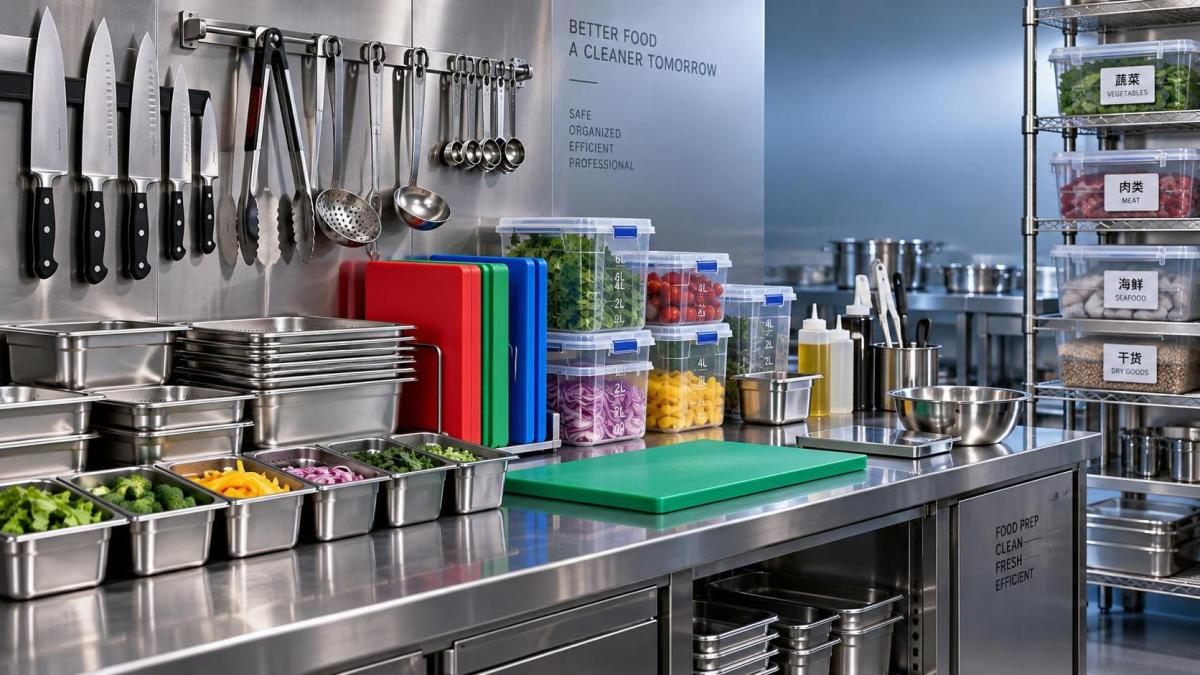
Materials Matter, but the Grade Alone Does Not Decide Performance
Stainless steel remains a common material for commercial kitchen utensils because it is durable, relatively easy to clean, and suitable for many wet or acidic food environments. However, “stainless steel” is not a complete specification. The relevant alloy, thickness, forming quality, weld finish, surface treatment, and intended use all deserve review. Stainless products are often offered in different grades, including grades commonly referred to as 304 and 430, but suitability should be assessed against the product design and operating environment rather than assumed from a grade label alone.
For cookware, trays, mixing bowls, ladles, and food pans, thin material may dent or warp under repeated thermal cycling. For knives, the balance between corrosion resistance, edge retention, and ease of sharpening matters more than a broad claim about “premium steel.” A very hard blade can retain an edge well but may require more specialized sharpening. A softer blade may be easier for staff to maintain, though it may need sharpening more often.
Polymer tools also need careful assessment. Food containers, cutting boards, spatulas, and handles should resist cracking, staining, odors, and deformation under the temperatures and chemicals used in the operation. A board that develops deep grooves becomes harder to inspect and clean. A plastic handle that loosens after repeated dishwashing creates a sanitation risk even if the metal component remains intact.
Build Food Safety Into the Tool Specification
Sanitation is not achieved by material selection alone. The shape of a tool often determines whether it can be cleaned reliably. Crevices around rivets, poorly finished welds, rough edges, damaged coating, trapped water inside hollow handles, and loose joints can all make routine washing less effective. When evaluating samples, inspect not only the visible surfaces but also underside details, handle connections, corners, and any part that may hold residue.
Tools intended for food contact should be supported by documentation appropriate to the destination market and the intended application. Requirements differ by country and by product type. Procurement teams should confirm applicable food-contact rules, material declarations, and any local requirements with the supplier and, where necessary, their quality or regulatory team. Do not assume that a document accepted for one market automatically satisfies another.
Color coding can support separation of raw proteins, produce, allergens, and ready-to-eat foods, but only when it is paired with staff training and a clear replacement process. A faded or damaged color-coded board is not a control measure. The same principle applies to labels and dedicated utensil storage: the system has to remain understandable during the busiest service period, not only when the kitchen is quiet.
Cleaning chemistry and heat exposure are part of the decision
Ask how tools will be washed: manual sink washing, commercial dishwashing, chemical sanitizing, or a combination. Heat, detergent concentration, water quality, and drying practices can shorten the life of unsuitable products. Rubberized grips, bonded components, coated surfaces, and certain plastics should be reviewed against the cleaning regime rather than selected solely for comfort or color.
Similarly, tools used near fryers, grills, combi ovens, or hot holding equipment need a stated temperature suitability that matches the real use case. It is sensible to request this information in writing. If a supplier cannot clearly explain the safe operating conditions, replacement parts, or care instructions, the product may be difficult to manage across multiple sites.
Evaluate Durability Through Service Life, Not Purchase Price
The lowest-cost utensil may be expensive if it bends, chips, loosens, or needs replacement after a short period. At the same time, the most expensive option is not automatically economical. A useful comparison considers purchase price, expected replacement frequency, cleaning time, maintenance needs, breakage risk, and the operational consequences of failure during service.
For high-use items, request samples and test them in a realistic setting. A short trial can reveal whether a scoop releases product cleanly, whether a tong mechanism remains smooth, whether a handle becomes uncomfortable when wet, or whether a food pan nests and separates easily. Users should be involved in the evaluation, but feedback needs structure. Ask them to comment on control, weight, cleaning difficulty, heat transfer, storage, and suitability for specific menu items.
Maintenance planning is especially important for knives, processors, mixers, and any tool with moving parts. Determine whether blades, seals, handles, guards, or other wear components can be replaced. Check the availability of spare parts in the destination region and clarify lead times before standardizing a tool across several locations. A durable product with no practical service support can still create downtime.
Standardize Where It Helps, but Keep Room for Menu-Specific Needs
Standardization simplifies purchasing, training, storage, and replacement. Common pan sizes, container lids, scoop capacities, and knife storage systems can reduce confusion between shifts and sites. This is particularly valuable for restaurant groups, hotels, commissaries, and foodservice operators with centralized procurement.
Yet standardization should not eliminate functional differences. A pastry section, sushi station, butcher area, bakery, and hot line have distinct requirements. The goal is not to force one tool into every task; it is to standardize the underlying system where possible while allowing specialist tools where they genuinely improve safety or output quality.
This distinction has become more relevant as commercial kitchens adopt automated prep equipment, digital inventory controls, smart cooking systems, and energy-conscious workflows. Basic kitchen tools still sit at the point where people handle food. Their dimensions, capacities, and storage methods should work alongside processors, holding equipment, dishwashing systems, and digital production routines. An automated vegetable cutter does not remove the need for properly sized collection bins, safe transfer tools, or clearly separated prep surfaces.
Use Supplier Evaluation to Reduce Delivery and Consistency Risks
Global sourcing has widened the available range of kitchen equipment and utensils. Manufacturing centers in China, Germany, Italy, Japan, and other markets offer different strengths in materials, design, tooling, and production scale. That variety is useful, but procurement should avoid judging suppliers solely by origin or quotation level.
For recurring purchases, confirm whether the quoted item is a stable production model, whether dimensions and materials are controlled consistently, and whether changes will be communicated before shipment. Request clear specifications, product drawings where relevant, packing details, minimum order requirements, and replacement-item availability. For imported goods, packaging strength, carton labeling, consolidation arrangements, and lead-time assumptions can matter as much as the tool itself.
A supplier should also be able to distinguish between a visual customization request and a functional change. Adding a logo may be straightforward; changing handle material, pan thickness, dimensions, or packaging can affect tooling, minimum quantities, testing, and delivery timing. These details should be settled before a tool is included in a multi-site rollout or opening order.
A Better Final Check Before Placing the Order
Before approval, review the shortlist against the conditions that matter in service: food type, daily use frequency, heat exposure, cleaning method, storage space, staff handling, replacement plan, and local compliance requirements. If several products appear similar, the deciding factor is often not the visible design. It is whether the tool can be cleaned thoroughly, handled safely when rushed, and replaced without disrupting the operation.
The strongest kitchen tools for restaurants are rarely the ones with the longest feature list. They are the tools that fit the workflow, remain dependable after repeated washing and handling, and make correct food preparation easier for staff to repeat. For larger projects, document the final selection in a tool schedule with item codes, dimensions, materials, approved substitutes, care requirements, and replenishment triggers. That turns a one-time buying exercise into a controlled operating system.
Popular Tags
Kitchen Industry Research Team
Dedicated to analyzing emerging trends and technological shifts in the global hospitality and foodservice infrastructure sector.
Industry Insights
Join 15,000+ industry professionals. Get the latest market trends and tech news delivered weekly.
No spam. Unsubscribe anytime.
Hot Articles

Contact With us
Contact:
Anne Yin (Ceramics Dinnerware/Glassware)
Lucky Zhai(Flatware)