
How to Choose a Bakery Worktable for Hygienic, High-Volume Dough Production
At the start of a busy production shift, a bakery worktable quickly becomes more than a flat surface. It is where ingredients are scaled, dough is mixed and divided, laminated sheets are rested, trays are staged, and cleaning routines either hold up or fall behind. For procurement teams responsible for commercial bakeries, central kitchens, hotels, and food processing facilities, the wrong table can create small daily frustrations that eventually turn into sanitation risks, staff fatigue, bottlenecks, and premature replacement costs.
Choosing the right Bakery Worktable for hygienic, high-volume dough production means looking beyond a catalog image or the lowest quoted price. The table must fit the product flow, withstand repeated loading and cleaning, provide a surface suitable for dough handling, and work safely within the available floor plan. This guide focuses on the specifications and practical questions that matter before a purchase order is issued.
Begin with the dough process, not the table dimensions
A worktable should be selected according to what happens on it during the busiest hour of the day. A bench used for weighing flour and preparing inclusions has different requirements from one used for rounding dough pieces, hand shaping artisan loaves, assembling filled pastries, or supporting trays before proofing.
Map the process in sequence: receiving ingredients, scaling, mixing, bulk fermentation, dividing, shaping, panning, proofing, baking, cooling, and packing. Then identify where staff need a stable preparation surface and what tools, containers, or trays must remain within reach. In high-output bakeries, a table that is merely “large enough” may still disrupt flow if operators repeatedly walk around it, share a congested surface, or move racks across an awkward aisle.
For example, a long central bench can suit a production line where several employees divide and shape dough in parallel. A compact wall-side table may be better for a dedicated scaling station. Mobile tables can add flexibility for changing menus or seasonal peaks, but they should not replace fixed workstations where precision and heavy mixing equipment demand maximum stability.
Procurement decisions become clearer when each proposed bakery worktable is assigned a role: ingredient preparation, dough handling, tray staging, packing, wash-down support, or temporary storage. One universal table design is rarely the best answer for every stage.
Surface material: why stainless steel grade deserves close attention
Stainless steel remains the standard choice for commercial food preparation because it is durable, non-porous, and easier to sanitize than painted steel, untreated timber, or low-grade composite surfaces. Yet “stainless steel” alone is not a complete specification. The grade, thickness, finish, and construction of the worktop affect its performance over years of use.
For many indoor bakery environments, 304 stainless steel is a practical choice. It offers good corrosion resistance and is well suited to frequent cleaning, flour dust, moisture, oils, sugars, and common food residues. Where the table is exposed to particularly aggressive cleaning chemicals, high humidity, salt-containing ingredients, or demanding processing conditions, procurement teams may consider 316 stainless steel. It generally provides stronger corrosion resistance, though whether the added cost is justified depends on the actual operating environment.
Do not overlook the gauge or thickness of the top. A thin sheet may look acceptable when new but can flex under a dough mixer bowl, flour bags, dough tubs, sheet pans, or repeated leaning by staff. Flexing creates noise, discomfort, and potentially hard-to-clean joints over time. A reinforced worktop, often supported by hat channels or a similar structural system underneath, is preferable where dough production involves heavy loads or continuous use.
The surface finish also matters. A smooth, food-safe finish should be easy to wipe down without being so highly polished that scratches and fingerprints become a constant visual issue. The goal is not decorative shine; it is a hygienic surface that remains serviceable under flour, water, cleaning agents, and daily abrasion.
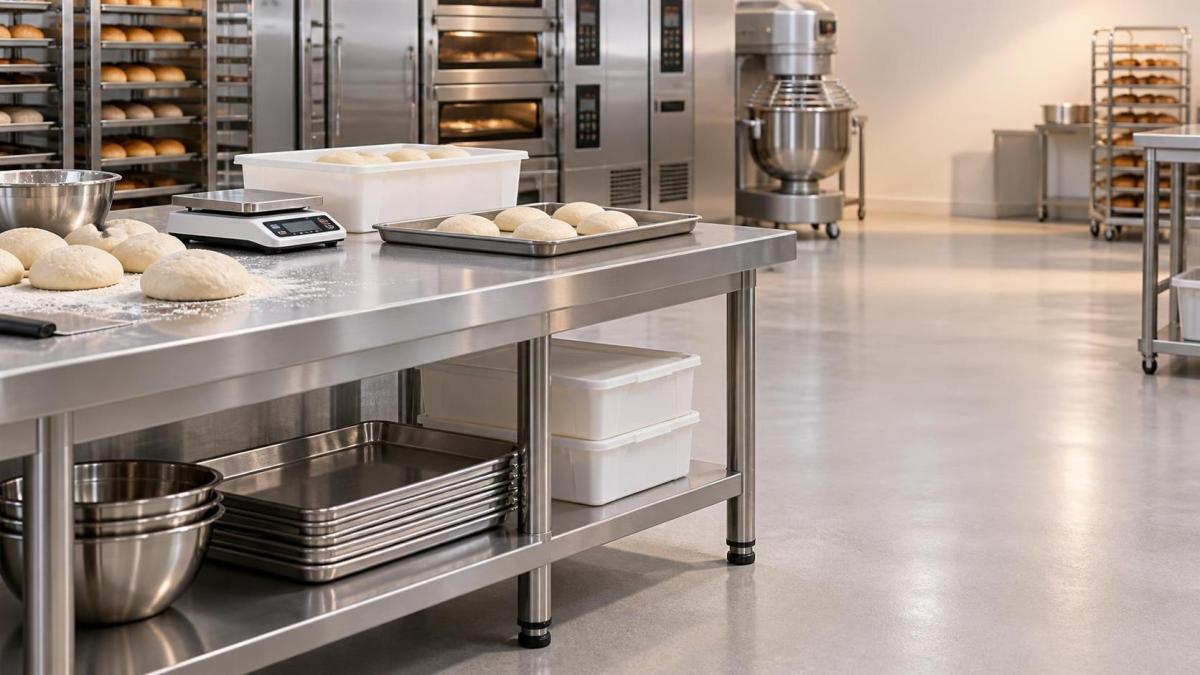
A stable table protects both consistency and staff comfort
Dough production is physical. Employees press, fold, scrape, portion, roll, lift, and transfer materials repeatedly. If the table wobbles, shifts, or sits at an unsuitable height, the impact is felt in every batch. For purchasing teams, stability should be treated as a food-production requirement rather than a minor furniture feature.
Check the frame construction, leg diameter, welded or bolted connections, adjustable feet, and bracing. Cross-bracing can improve rigidity, particularly on longer tables or models carrying undershelves. Adjustable feet are valuable even on apparently level floors because a slight imbalance can lead to rocking. They also help maintain a stable working plane when facilities have drainage slopes.
Height requires a more nuanced decision than simply ordering the standard available size. A typical work height may be suitable for general preparation, but a task involving intensive kneading or shaping may benefit from a lower surface, while packing, decorating, or tray assembly may call for a different ergonomic position. If several work areas serve different functions, standardizing every table at one height can be less efficient than choosing task-appropriate heights.
Where staff of different heights share the same station, consider the workflow and the duration of each task. The aim is to reduce unnecessary bending, shoulder strain, and awkward reaching without compromising the ability to apply controlled pressure to dough.
Dimensions should be calculated from production volume and clearance
It is tempting to purchase the largest bakery worktable that fits through the door. In a working bakery, however, table depth and aisle clearance can matter as much as overall length. A deep bench may create a generous surface but make it difficult to reach the center for cleaning or dough handling. A narrow table may preserve circulation but leave no space for dough tubs, scales, trays, and hand tools at the same time.
Ask suppliers for complete dimensions, including the footprint of legs, undershelf overhangs, casters, bumpers, and any raised rear edge. Then lay out the table in the actual production plan, allowing for:
- Safe movement of bakery racks, ingredient carts, and tray trolleys;
- Door swings, refrigeration access, and emergency routes;
- Cleaning access around walls and beneath equipment;
- Space for operators to work without backing into another station;
- Temporary staging during peak production, not only normal output.
For high-volume operations, it is often better to use two properly spaced worktables than one oversized island that creates a traffic obstruction. Modular layouts also make future expansion easier when a bakery adds a divider, sheeter, proofer, automated depositor, or digital production management system.
Undershelves, drawers, and backsplashes: useful features when they support hygiene
Storage under a worktable can reduce wasted motion. Dough scrapers, measuring containers, bowls, sheet pans, and frequently used tools remain close to the operator instead of being stored across the room. An open undershelf is common because it is accessible and does not introduce enclosed corners. Still, it should have enough clearance from the floor for mopping and should not become a permanent dumping area for damaged trays or unused packaging.
Drawers can be helpful at a controlled prep station, especially for small tools or records, but they add seams, runners, and cleaning points. Choose them only when the operational benefit is clear and confirm that the drawer construction can be accessed and cleaned properly. For raw dough production, open storage may be more practical than multiple enclosed compartments.
A rear backsplash can protect walls from flour, water, and splashes when a table sits against a wall. It is less useful on a central island and can interfere with handling large dough sheets or trays from more than one side. Similarly, raised edges may help contain ingredients in some applications, but they may obstruct bench scrapers or make it harder to slide trays across the surface. Features should follow the task, not a generic specification checklist.
Fixed legs or casters? Choose mobility with discipline
Casters are attractive in flexible production areas. A mobile bakery worktable can be moved for deep cleaning, reconfigured for a new product run, or rolled closer to a machine during changeovers. In facilities where space is shared among pastry, bread, and packing teams, this adaptability can be genuinely valuable.
But mobility introduces responsibility. Casters should be foodservice-grade, durable, easy to clean, and equipped with reliable brakes. Locking only one wheel is rarely enough for a table that will receive heavy dough tubs or repeated manual force. Consider wheel material as well: it should suit the floor finish and resist degradation from wash-down chemicals.
For hand-kneading, sheeting support, or stations near large mixers, fixed legs usually offer greater confidence. A sensible hybrid layout often works best: fixed tables for core production points and mobile tables for staging, packing, and support tasks.
Cleaning design is where low-cost tables often reveal their limitations
Food safety is not achieved by material selection alone. It depends on how readily a team can clean the table at the end of a shift and during production breaks. Look closely at the underside of the worktop, shelf corners, leg joints, caster housings, and the connection between any backsplash and table surface. Crevices, exposed fasteners, rough welds, and poorly sealed seams can collect flour paste, grease, moisture, and debris.
Specify smooth welds where possible and avoid designs with unnecessary gaps. Rounded corners reduce snagging and simplify wipe-down. Open-leg designs may be easier to clean than heavily enclosed bases, although the right option depends on storage needs and local sanitation protocols.
Procurement teams should also confirm which cleaning agents will be used. Chloride-containing chemicals, abrasive pads, and improper rinsing can damage stainless steel over time, even when the table is made from a suitable grade. A supplier that provides clear care guidance helps maintenance teams protect the investment rather than unintentionally shortening its service life.
Load capacity is not just about the maximum weight
Manufacturers may state a load rating, but buyers should ask how that rating applies in real conditions. Is it evenly distributed across the worktop? Does it include the undershelf? Is the table expected to support static storage only, or can it tolerate the repeated impact of tubs and trays being set down throughout the day?
Estimate the heaviest realistic combination: ingredient containers, dough bins, mixing bowls, trays, small countertop equipment, and the force applied during work. If the table will support a planetary mixer, dough divider, or other appliance, verify not only its weight but also vibration and mounting requirements. Some equipment needs a dedicated stand rather than a general-purpose bakery bench.
Underestimating load requirements often leads to bent shelves, loosened joints, uneven surfaces, and a shortened replacement cycle. Selecting a table with suitable structural margin is usually more economical than treating it as disposable equipment.
Questions to include in the supplier evaluation
Before comparing quotations, create a specification sheet that allows like-for-like evaluation. Price differences become more meaningful when the construction details are visible. Ask suppliers to confirm the stainless steel grade, top thickness, reinforcement method, overall and usable work surface dimensions, table height, load capacity, leg and shelf construction, caster details if applicable, weld finishing, and assembly requirements.
Also ask practical service questions: Can replacement casters, feet, shelves, or drawers be supplied? Is the table delivered welded or knocked down? Will it fit through receiving doors and production corridors? Are custom dimensions available if the standard range leaves unusable gaps in the layout? For international procurement, packaging quality and shipping protection deserve attention as well, since dented stainless surfaces are difficult to restore perfectly.
A better decision balances sanitation, flow, and lifecycle value
The best bakery worktable is rarely the one with the longest list of accessories. It is the one that gives production staff a clean, stable, appropriately sized place to work day after day, while allowing supervisors to maintain food safety standards without turning cleaning into a difficult extra task.
For high-volume dough production, prioritize a hygienic stainless steel surface, robust reinforcement, reliable stability, dimensions matched to actual workflow, and a design that can be cleaned from every practical angle. Add shelves, backsplashes, drawers, or casters only when they improve the way the bakery operates. With that approach, a worktable becomes a dependable part of the production system—supporting consistent output today and making future changes in capacity, automation, or layout easier to manage.
Popular Tags
Kitchen Industry Research Team
Dedicated to analyzing emerging trends and technological shifts in the global hospitality and foodservice infrastructure sector.
Industry Insights
Join 15,000+ industry professionals. Get the latest market trends and tech news delivered weekly.
No spam. Unsubscribe anytime.
Hot Articles


Contact With us
Contact:
Anne Yin (Ceramics Dinnerware/Glassware)
Lucky Zhai(Flatware)