
How to Choose Restaurant Supplies for Food Trucks Without Wasting Space or Budget
What “Choosing Restaurant Supplies for Food Trucks” Really Means
The biggest mistake in sourcing restaurant supplies for food trucks is treating the truck like a smaller restaurant. It is not. A food truck is a production kitchen, a storage room, a point-of-sale counter, and a vehicle platform compressed into one moving workspace. That changes how every purchasing decision should be evaluated. In a fixed restaurant, an oversized prep table is wasteful but manageable. In a truck, the same mistake can block movement, increase heat load, reduce storage, and make cleaning harder. Space loss quickly becomes labor loss.
For that reason, procurement is not really about finding the cheapest equipment list. It is about building a working system inside strict limits: available footage, electrical capacity, ventilation, water access, holding temperatures, menu flow, and local compliance requirements. A piece of equipment may look economical on paper and still be expensive in practice if it forces extra generator capacity, creates bottlenecks during service, or requires constant replacement because it was designed for lighter-duty use.
That is why experienced buyers usually start with the menu and service model, not the catalog. A truck selling coffee and packaged pastries needs a very different supply mix than one producing fried foods, griddled items, or made-to-order bowls. “Restaurant supplies for food trucks” is not a generic category. It is a selection problem shaped by throughput, utility constraints, and sanitation realities.
Start with workflow, not equipment count
When buyers waste space, it is often because they purchase by item type instead of by task sequence. The truck does not care how complete the equipment list looks. It only reflects whether staff can receive, store, prep, cook, assemble, serve, and clean without crossing into each other every few seconds.
A better approach is to map the actual movement of food and staff. Cold storage should sit close to prep. Prep should sit close to the primary cooking line. Hot holding or finishing stations should be positioned so plated or packaged items reach the service window without turning the aisle into a collision zone. Even small decisions matter here: door swing direction, shelf height, undercounter access, and whether dry storage is reachable during rush periods.
This is also the point where many buyers realize they do not need more equipment; they need more multifunctionality. A compact refrigerated prep table can replace separate cold storage and staging in some truck layouts. Shelving that supports ingredient bins, disposables, and cleaning supplies in vertical layers may free more usable space than adding another cabinet. The core question is not “What else should we buy?” but “What task does this item remove, combine, or simplify?”
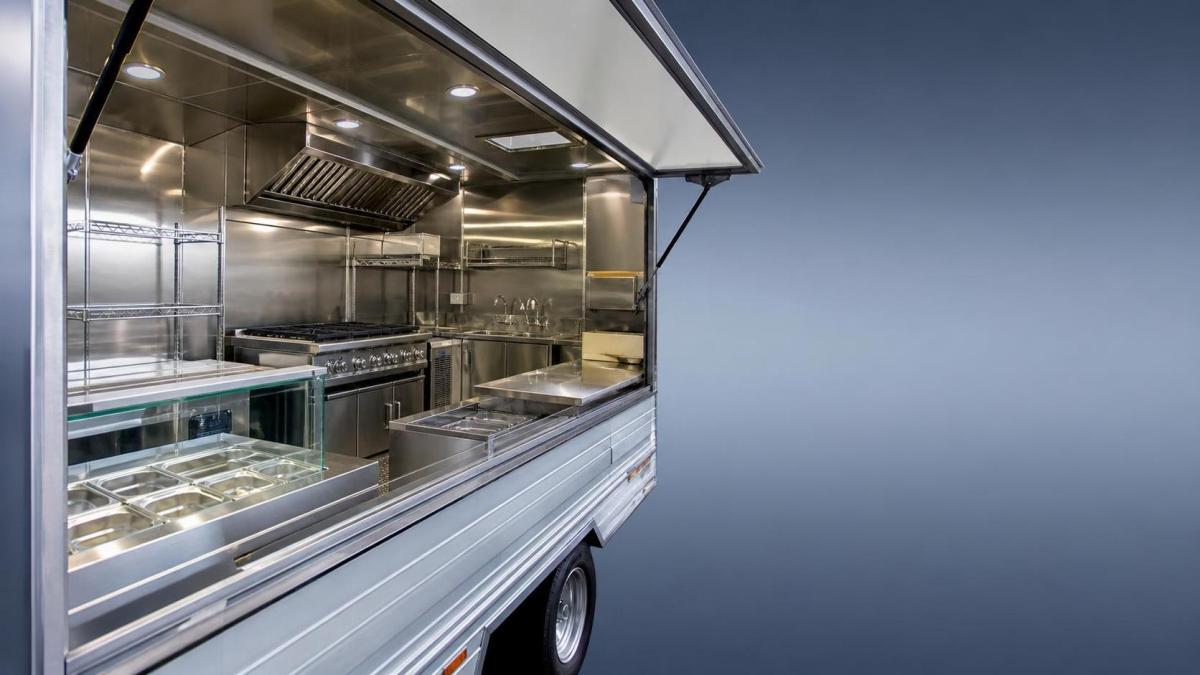
Space efficiency is not the same as buying the smallest unit
There is a common misunderstanding in mobile kitchen procurement: if space is tight, every unit should be as small as possible. In practice, undersizing can be just as costly as oversizing. A refrigerator that is too small forces more frequent restocking and may compromise temperature recovery during busy service. A fryer that cannot keep up with volume creates wait times and uneven output. A sink arrangement that barely meets the minimum may slow sanitation routines enough to affect the whole shift.
Useful space efficiency comes from matching capacity to peak demand, then removing dead space around the equipment. That means evaluating external dimensions and internal productivity together. Buyers should compare not only width and depth, but also clearance needs, lid or door access, service access, and how the unit performs under repeated opening, high ambient heat, or generator-powered operation if applicable.
This is one reason equipment spec sheets should never be read in isolation. A 27-inch unit may fit on the plan, but once you account for safe spacing, operator stance, drain routing, and ventilation requirements, the real footprint is larger. In a truck, nominal dimensions are only the beginning.
Where budget mistakes usually happen
Overspending rarely comes from one dramatic purchase error. More often it comes from a string of small mismatches. Buyers pay for duplicate functions, add accessories that do not support the menu, or select light-duty supplies that need early replacement. The invoice may still look reasonable, but the operating cost does not.
There are four budget traps worth watching closely:
- Buying for theoretical menu expansion. If a truck may add grilled items later, that does not automatically justify installing a griddle now.
- Ignoring utility cost implications. Equipment choice affects power draw, fuel use, heat generation, and ventilation burden.
- Paying twice for storage. Separate ingredient containers, shelving, and backup holding often multiply because the layout was not resolved first.
- Choosing household-grade or borderline commercial items for a commercial mobile environment. Initial savings disappear quickly if reliability drops.
A disciplined budget for restaurant supplies for food trucks should therefore separate essential production equipment, code-driven items, workflow-support accessories, and optional future upgrades. Once these categories are mixed together, low-priority purchases tend to hide inside the total.
The equipment list should follow the menu’s production logic
Procurement becomes much clearer when each supply item can be tied to a menu step. If an ingredient is stored cold, portioned in advance, finished on a griddle, and handed out in disposable packaging, the supporting equipment chain is easy to test. If a unit cannot be linked to a repeated operational step, it may not belong in the truck.
This is especially useful for deciding between prep-intensive and assembly-intensive formats. Trucks that prep heavily on board need stronger emphasis on worktables, refrigerated ingredient access, sink usability, and waste handling. Trucks that do most prep in a commissary and finish items on site may prioritize holding, reheating, fast assembly, and packaging storage instead. The same menu category can produce different equipment needs depending on how much of the production process happens inside the vehicle.
That distinction matters because many food trucks are operationally hybrid. They are not fully self-contained kitchens in the way new operators sometimes imagine. Procurement should reflect the real production boundary between commissary, truck, and service window.
Compliance items are not secondary purchases
In mobile foodservice, compliance-related supplies are often treated as administrative details until late in the project. That is backwards. Handwashing access, warewashing setup, food-safe surfaces, temperature control, ventilation, fire protection compatibility, and potable-to-waste water arrangements are not finishing touches. They influence layout, utilities, and usable working area from the beginning.
Requirements vary by jurisdiction, so buyers cannot assume that a truck design or supply package that worked in one city will pass in another. Health department and fire code review often shape sink configuration, hood requirements, suppression integration, and approved materials. Where certification marks are expected for commercial foodservice equipment, that should be checked early rather than after installation planning. The point is not to overload the buying process with paperwork; it is to avoid purchasing equipment that fits physically but fails operational approval.
From a budgeting standpoint, compliance-driven supplies should be treated as core infrastructure. If they are squeezed into the last phase, operators often sacrifice more productive equipment or storage later to make room.
Durability in a truck means more than stainless steel
Buyers often use stainless construction as a shorthand for durability, but mobile kitchens place different stresses on equipment than static kitchens do. Vibration, repeated transport, door opening frequency, curbside leveling issues, grease buildup in compact zones, and exposure to outdoor heat all affect service life. So the real question is not whether a unit looks commercial, but whether it can hold up in a moving, high-turn environment.
That shifts attention toward hinges, latches, shelf supports, gasket quality, caster or mounting compatibility where relevant, and ease of cleaning around tight edges. It also favors simpler designs in some categories. In confined operations, a unit that is easy to clean, easy to service, and easy to reset after a busy shift may outperform a feature-heavy model whose extras add little operational value.
Smallwares deserve the same scrutiny. Ingredient bins, cutting boards, storage containers, dispensers, pans, and utensils get used continuously and often have a direct effect on speed and sanitation. These are not minor line items just because the ticket price is lower.
A practical evaluation frame for buyers
When comparing restaurant supplies for food trucks, it helps to score each item against a short set of real operating questions rather than against brand familiarity alone.
This kind of framework tends to expose weak purchases quickly. If an item scores poorly on task fit and utility impact, it is probably a convenience purchase rather than a necessary one.
What experienced buyers usually leave out
One sign of mature procurement is not just what gets selected, but what gets excluded. Buyers with mobile foodservice experience often resist broad equipment packages because bundled lists tend to assume a standard kitchen model. They also avoid filling every open gap with storage hardware. An overbuilt truck can become harder to clean, harder to move in, and harder to adapt when the menu changes.
Leaving space uncommitted is sometimes the right decision. A small open zone near the service line may create more daily value than another shelf. So may a simpler countertop arrangement that allows faster packaging during peak traffic. Procurement is not successful because the truck looks fully equipped. It is successful when the operation runs without friction.
The useful decision rule
If a supply item for a food truck does not clearly improve throughput, food safety, storage efficiency, or labor movement, it deserves a second look. That rule sounds strict, but it reflects the economics of mobile kitchens. Space is inventory. Power is limited. Heat accumulates quickly. Every inch and every watt should earn its place.
The best purchasing decisions usually come from viewing the truck as an integrated operating environment rather than a list of appliances. Once that shift happens, budget control gets easier. So does equipment selection. You stop asking which product has the longest feature list and start asking which combination will let a real crew work cleanly, quickly, and consistently inside a very small box. That is the practical standard worth using.
Popular Tags
Kitchen Industry Research Team
Dedicated to analyzing emerging trends and technological shifts in the global hospitality and foodservice infrastructure sector.
Industry Insights
Join 15,000+ industry professionals. Get the latest market trends and tech news delivered weekly.
No spam. Unsubscribe anytime.


Contact With us
Contact:
Anne Yin (Ceramics Dinnerware/Glassware)
Lucky Zhai(Flatware)