How to Choose Glass Nut Jars That Protect Freshness and Prevent Breakage
Choosing the right glass nut jar is essential for procurement teams seeking reliable food storage, product protection, and consistent shelf presentation.
The best choice balances freshness performance, glass strength, closure reliability, filling-line compatibility, transport risk, and total purchasing cost rather than focusing only on unit price.
For buyers, the core search intent is practical supplier evaluation: identifying a glass nut jar that preserves product quality while reducing breakage, complaints, waste, and operational disruption.
Procurement teams typically need clear specifications, measurable quality standards, packaging guidance, and supplier questions that support confident comparison across domestic and international sources.
Start With the Real Risk: Freshness Loss and Distribution Damage
Nuts are naturally vulnerable to oxidation, moisture absorption, odor transfer, and physical damage, especially when products remain in storage or retail channels for extended periods.
A suitable glass nut jar should create a stable barrier around the product while also surviving filling, capping, case packing, pallet movement, transport, and consumer handling.
Glass itself is highly effective at blocking moisture and external odors, but the complete package performs only as well as its lid, liner, seal, and handling design.
Buyers should therefore avoid treating jar selection as a simple packaging purchase. It is a product-protection decision that affects shelf life, brand perception, and supply-chain cost.
The first procurement question should be whether the jar will protect the intended nut type under actual distribution conditions, not whether it merely looks attractive in a sample room.
Almonds, walnuts, cashews, pistachios, mixed nuts, roasted seeds, and flavored snack blends can have different oil content, particle size, aroma intensity, and moisture sensitivity.
Products containing seasoning powders or oils may need stronger sealing performance because residue around the neck finish can interfere with consistent cap application and resealing.
For premium retail products, visual transparency may be a major selling point. For light-sensitive ingredients, however, clear glass may require secondary packaging or tinted alternatives.
Before requesting quotations, define the expected shelf life, storage environment, filling method, distribution distance, retail format, and estimated number of handling events.
This operating profile gives suppliers meaningful information and helps purchasing teams compare jars according to risk rather than accepting generic recommendations based on capacity alone.
Choose Glass Quality and Wall Thickness for the Actual Supply Chain
Not all glass containers offer the same breakage resistance. Jar strength depends on glass composition, wall distribution, base design, finish quality, and manufacturing consistency.
Soda-lime glass is commonly used for food packaging because it is economical, recyclable, chemically stable, and available in many standard shapes and capacities.
For most nut products, soda-lime glass is appropriate when the supplier maintains dependable forming control and the selected jar is matched to transport conditions.
Wall thickness matters, but a heavier jar is not automatically safer. Uneven thickness can create weak points that make the container more vulnerable to impact.
Ask suppliers for nominal weight, dimensional tolerances, wall-thickness distribution data, and details about the glass manufacturing process used for the proposed glass nut jar.
A thicker base can improve stability on production lines and retail shelves, particularly for wide jars filled with dense nut mixes or larger package sizes.
However, unnecessary glass weight increases freight costs, pallet weight, energy use, and handling burden. Buyers should evaluate strength per unit rather than maximum weight.
Jar geometry also changes breakage risk. Sharp shoulders, narrow bases, and highly angular decorative forms may create stress concentrations during impact or packing operations.
Round jars generally provide better load distribution and easier handling. Square jars can improve shelf utilization but require more careful carton design and separator selection.
Inspect the finish and mouth carefully. Chips, cracks, rough edges, and inconsistent threads can cause cap problems, operator injuries, leakage, and rejected filled products.
For high-volume programs, specify acceptance criteria for cosmetic defects, finish damage, embedded foreign material, bubbles, stones, and dimensional variation before production begins.
Supplier quality documentation should identify sampling procedures, inspection frequency, traceability systems, and corrective-action processes when defects exceed agreed limits.
Make the Closure System the Center of Freshness Protection
A glass nut jar preserves freshness only when its closure creates and maintains a reliable seal. The lid and liner deserve the same scrutiny as the container.
Common options include metal lug caps, continuous-thread metal caps, aluminum caps, plastic screw caps, and specialty closures designed for premium gifting or reusable storage.
For mainstream retail nuts, a metal twist cap with a suitable food-contact liner often offers a strong combination of sealing performance, appearance, and consumer familiarity.
Plastic closures may reduce weight and resist denting, but buyers should verify torque consistency, liner performance, recycling requirements, and suitability for the target market.
The liner is particularly important because it contacts the jar finish and creates the barrier against air exchange, moisture ingress, and potential product leakage.
Evaluate liner materials according to the product’s oil content, salt level, flavoring ingredients, expected storage temperature, and local food-contact compliance requirements.
If oxygen control is important, consider whether the pack will use nitrogen flushing, oxygen absorbers, induction sealing, or another shelf-life extension approach.
Induction seals can provide visible tamper evidence and a strong initial barrier. They also require compatible cap components, equipment settings, and dependable application control.
For jars intended to be repeatedly opened, test reseal performance after multiple consumer-use cycles. A strong initial seal does not guarantee adequate household usability.
Request closure torque specifications and verify that the supplier’s recommended range matches your filling equipment and expected operator controls on the production line.
Too little torque can cause leaks or seal failures. Excess torque can damage threads, distort liners, frustrate consumers, and create opening complaints at retail.
When purchasing jars and caps from separate suppliers, assign responsibility clearly. Compatibility failures often emerge when neither party owns the complete packaging system.
Select Capacity and Shape Based on Product Fill, Not Label Volume
Jar capacity should be based on the actual product fill weight, bulk density, desired headspace, filling accuracy, and visual presentation rather than a nominal milliliter figure.
Nuts vary significantly in density. Whole cashews, walnut halves, peanuts, pistachios, and trail mixes can occupy very different volumes at the same declared net weight.
Ask the supplier for brimful capacity, overflow capacity, recommended fill level, internal diameter, neck opening, external dimensions, and usable label panel measurements.
Conduct physical fill trials with the final product whenever possible. Digital drawings cannot fully predict settling behavior, headspace appearance, or product flow through filling equipment.
Excessive headspace can make a package look underfilled and may leave more oxygen available inside the jar. Insufficient headspace can complicate capping and product protection.
Wide-mouth jars are often preferred for nuts because they support easy filling, consumer access, scooping, and visible product display. They can also simplify cleaning in reuse scenarios.
Narrower openings may reduce the exposed opening area but can slow manual filling and make large nuts more difficult to dispense without breakage.
Consider the retail shelf planogram when selecting shape. A visually distinctive jar may command attention, while a standard cylindrical design can improve case density and replenishment efficiency.
For foodservice buyers, larger jars may reduce packaging consumption and labor. They also increase consequences when a single container breaks during storage or kitchen handling.
Choose a capacity that fits the target customer’s consumption rate. Oversized packs can expose opened nuts to oxidation for longer periods after the initial seal is broken.
Evaluate Breakage Beyond the Jar: Secondary Packaging Is Critical
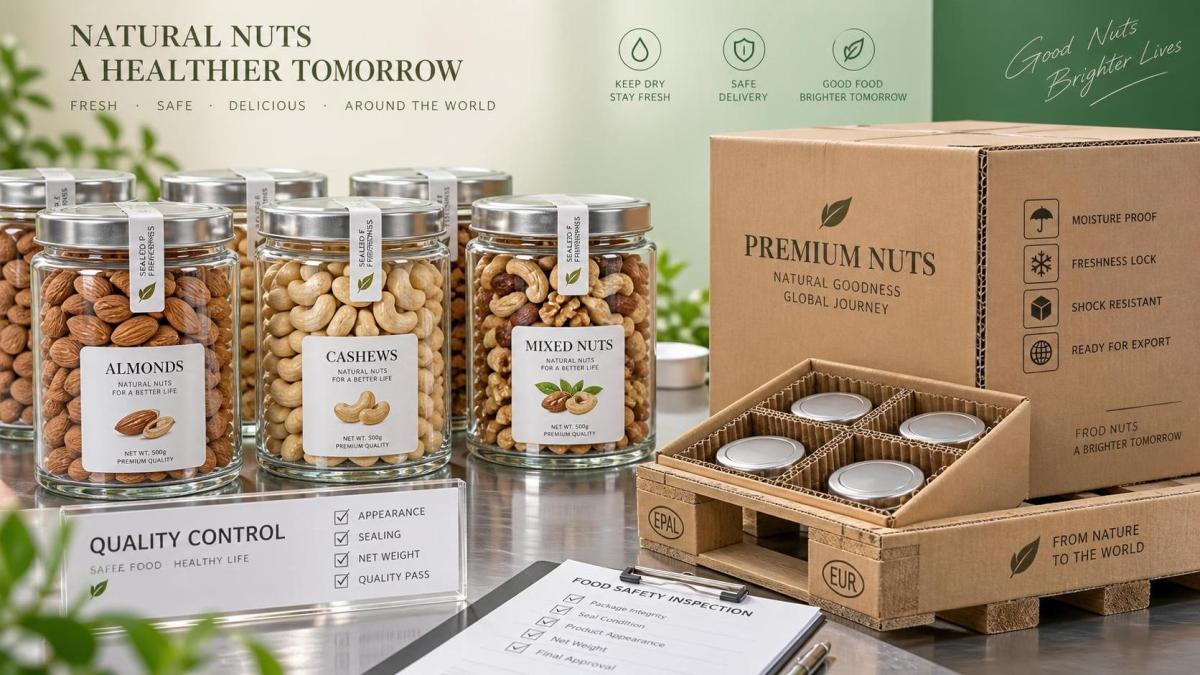
Many jar failures occur after production, not during manufacturing. Outer cartons, dividers, tray systems, shrink wrapping, pallet patterns, and loading practices determine real-world survival.
A strong glass nut jar can still break if containers touch each other inside a carton or if the case lacks sufficient resistance to compression and vibration.
Ask suppliers how jars are packed: bulk packed, partitioned, cell-divided, tray packed, shrink bundled, or individually separated with protective material.
Bulk packing may reduce packaging cost, but it can increase scratches, chips, and breakage. It is usually unsuitable for long-distance shipments or premium finished goods.
Partitioned cartons generally provide better protection because they prevent glass-to-glass contact. They also improve warehouse counting and support more orderly line feeding.
Carton strength should be selected according to stacking height, humidity exposure, transport mode, and pallet configuration. Recycled paper content and storage conditions can affect performance.
For exports, specify pallet dimensions, maximum pallet height, layer pattern, stretch-film method, corner protection, and whether top-load protection is required.
Containerized ocean freight exposes goods to vibration, shifting loads, temperature variation, and moisture. Export packing should be validated separately from local truck distribution.
Ask for drop-test, vibration-test, compression-test, or transit-test information when the program has meaningful volume or a history of breakage claims.
Testing should use filled jars whenever possible. Empty-container performance can be misleading because product weight changes internal forces, center of gravity, and carton loading.
Breakage targets should be part of the purchasing agreement. A supplier commitment based only on visual inspection is insufficient for a package moving through complex logistics networks.
Verify Food Safety, Compliance, and Product Traceability
Food-contact compliance is a basic requirement, but procurement teams should verify documentation before approving a supplier or releasing any order for food packaging use.
Depending on the destination market, relevant requirements may include FDA rules, EU food-contact regulations, REACH-related declarations, California Proposition 65 considerations, or local standards.
Request declarations covering glass, coatings, inks, caps, liners, seals, and any decorative components. The complete finished package must be assessed, not only the jar body.
For colored or decorated jars, confirm that external coatings will not flake, transfer, or degrade under expected washing, transport, refrigeration, or retail lighting conditions.
Supplier certifications such as ISO 9001, BRCGS Packaging Materials, FSSC 22000, or equivalent systems can indicate process discipline, but certificates should not replace product testing.
Traceability should link each shipment to production dates, manufacturing lines, material batches, inspection records, and packing records. This is essential if a complaint requires investigation.
For branded retail programs, retain approved reference samples that define acceptable color, clarity, finish quality, closure appearance, labeling position, and carton construction.
These references make incoming inspection more objective and reduce disagreement when production lots differ from initial samples or purchase-order expectations.
Compare Suppliers Using Total Cost, Not the Lowest Quotation
The lowest ex-factory jar price can become the most expensive option when breakage, inconsistent dimensions, poor packing, delayed deliveries, or closure failures affect operations.
Calculate landed cost by including jar price, cap price, decoration, cartons, pallets, freight, insurance, duties, quality inspection, storage, line losses, and expected damage allowances.
Compare supplier quotations using the same technical specification. Differences in glass weight, finish type, carton count, closure liner, or palletization can distort apparent savings.
Lead time is also a procurement risk. Standard catalog jars may be available quickly, while custom molds, colors, embossing, and special closures require longer development schedules.
Custom molds can support brand differentiation, but they increase upfront investment and make switching suppliers more difficult if performance or service later becomes unacceptable.
For recurring demand, assess the supplier’s capacity, mold maintenance practices, backup production capability, raw-material sourcing, export experience, and inventory planning process.
Ask whether the supplier can support forecast-based stock, safety inventory, multiple shipment releases, and consistent color matching over repeated production runs.
Payment terms should be considered alongside quality controls. Larger deposits or long production windows may increase exposure if the supplier has not completed full qualification.
A structured supplier scorecard helps teams compare offers consistently. Weight factors such as quality, seal compatibility, breakage protection, compliance, lead time, service, and total cost.
Use Samples and Trials Before Issuing a Large Purchase Order
Samples are useful only when they represent planned production. Buyers should request samples from the intended mold, glass color, finish, closure, decoration method, and carton system.
Begin with visual review, dimensional checks, and cap-fit testing. Then perform filling trials using the actual nuts, expected line settings, and intended headspace target.
Measure cap torque, inspect liner contact, check tamper-evidence features, and assess how easily consumers can open and reseal the package after normal use.
Conduct transport simulations or controlled handling tests before approving the final packaging specification. Include drops, stacking, vibration, and temperature exposure where relevant.
Evaluate appearance after testing. A jar that remains intact but develops scratches, cap dents, label scuffs, or loose decoration may still be unsuitable for retail presentation.
For high-value launches, use a pilot shipment before committing to a full container. This reveals handling issues that laboratory tests and factory samples may not capture.
Document every approved specification in the purchase order, including drawings, tolerances, closure details, carton configuration, pallet requirements, inspection standards, and claim procedures.
Build a Clear Specification for Every Glass Nut Jar Program
A complete specification reduces ambiguity and makes supplier performance easier to manage. It should describe both the primary jar and the protective system around it.
Include jar style, glass color, brimful capacity, target fill weight, jar weight, dimensions, neck finish, thread type, closure material, liner type, and torque range.
State permitted cosmetic defects, critical dimensional tolerances, food-contact documents, carton count, divider design, pallet pattern, labeling requirements, and maximum acceptable breakage rate.
Define who pays for replacement products, freight, inspection, or disposal when breakage exceeds the agreed threshold or packaging does not meet the approved standard.
Clear requirements also help suppliers offer meaningful improvements. They can recommend a stronger base, better divider, compatible cap, or more efficient pallet pattern with confidence.
Conclusion: Choose the Package System, Not Just the Jar
The right glass nut jar protects product quality when its glass strength, closure performance, capacity, and transport packaging are designed as one integrated system.
For procurement teams, the strongest decision is based on fill trials, documented specifications, compliance verification, transit testing, and total-cost comparison across qualified suppliers.
A lower-priced jar may be appropriate when distribution is short and controlled. More demanding retail or export programs require stronger evidence of sealing and breakage performance.
By evaluating the full package instead of the container alone, buyers can protect freshness, reduce supply-chain losses, support shelf presentation, and build a more dependable packaging program.