
Glass Candy Jars: How to Choose the Right Size, Lid, and Display Style
Choosing a glass candy jar is more than a packaging decision. In a bakery counter, hotel buffet, specialty grocery aisle, or self-service confectionery shop, the jar influences what customers see, how easily staff can serve, how long products stay appealing, and how efficiently a purchasing team can replenish stock. A jar that looks generous but is awkward to clean, too heavy to move, or poorly sealed can become an everyday operational nuisance.
For procurement professionals, the right choice is rarely the largest, clearest, or least expensive option. It is the jar that fits the product, service model, display environment, and replacement plan. This guide looks at the practical decisions behind glass candy jars: capacity, opening size, lid design, material durability, display style, and the details that matter after the first delivery arrives.
Start with the way candy will actually be sold or served
Before comparing jar dimensions, define the handling model. A glass candy jar used as a decorative centerpiece in a hotel lounge has very different requirements from one placed at a busy pick-and-mix station. The product itself also matters. Individually wrapped sweets, hard candies, chocolate-coated items, gummies, nuts, cookies, and loose confectionery do not behave the same way in storage.
Ask a few operational questions early:
- Will customers scoop products themselves, or will staff serve from behind a counter?
- How often will the jar be opened during a service period?
- Will products be sold by weight, by piece, or as a visual impulse purchase?
- Is the display exposed to warm lighting, humidity, sunlight, or frequent handling?
- Does the team need to refill jars during peak hours without disrupting the presentation?
A beautiful oversized vessel can be a poor fit for slow-moving premium candy. Product at the bottom may remain there for too long, while repeated topping-up creates an inconsistent stock rotation practice. Conversely, a small jar may force staff to refill constantly in a high-volume café or convenience retail setting. Procurement should therefore assess capacity in relation to expected turnover, not visual scale alone.
Choosing the right glass candy jar size
Capacity is often described in milliliters, liters, ounces, or gallons, but buyers should not rely on a nominal volume alone. Candy shape, wrapping, and settling patterns significantly affect usable capacity. Round sweets leave more air gaps than compact cubes; wrapped items need more room than loose drops; fragile products should not be packed to the rim.
Small jars: controlled portions and premium presentation
Small glass jars are commonly suited to counter displays, sample stations, guest-room amenities, gift bundles, and premium confectionery. They encourage a curated look and make it easier to rotate products frequently. Their limitations are equally clear: opening and refilling many small containers takes time, and a crowded assortment can make staff lose track of product codes, allergens, or best-before dates.
For purchasing teams, smaller formats work best when variety is a selling point and inventory movement is moderate. Consider ordering compatible labels, scoops, and replacement lids at the same time rather than treating the jar as an isolated item.
Medium jars: the most flexible option for everyday displays
Medium-capacity glass candy jars usually offer the best balance between visibility and practicality. They can hold a meaningful quantity of confectionery without becoming difficult to lift or clean. This format is often appropriate for café counters, dessert shops, hotel breakfast areas, retail shelves, and reception displays.
When assessing a medium jar, focus on the usable opening. A jar may have ample interior volume but a narrow neck that makes refilling, cleaning, and retrieving the last portion inconvenient. A wide-mouth design is generally easier for staff to manage and more compatible with standard serving scoops.
Large jars: strong visual impact, but only when turnover supports them
Large jars can create an abundant, traditional confectionery-shop appearance. They are effective for bulk displays, self-service zones, promotional tables, and high-traffic foodservice areas. Yet the visual benefit should be balanced against weight, breakage risk, cleaning labor, and product freshness.
For large containers, check whether a full jar can be lifted safely by one employee and whether shelving can support the loaded weight. A jar that is manageable when empty may become impractical once filled with dense candy, coated nuts, or chocolate products. It can also be wise to use large jars for high-turnover, shelf-stable items and reserve smaller formats for delicate or slower-moving lines.
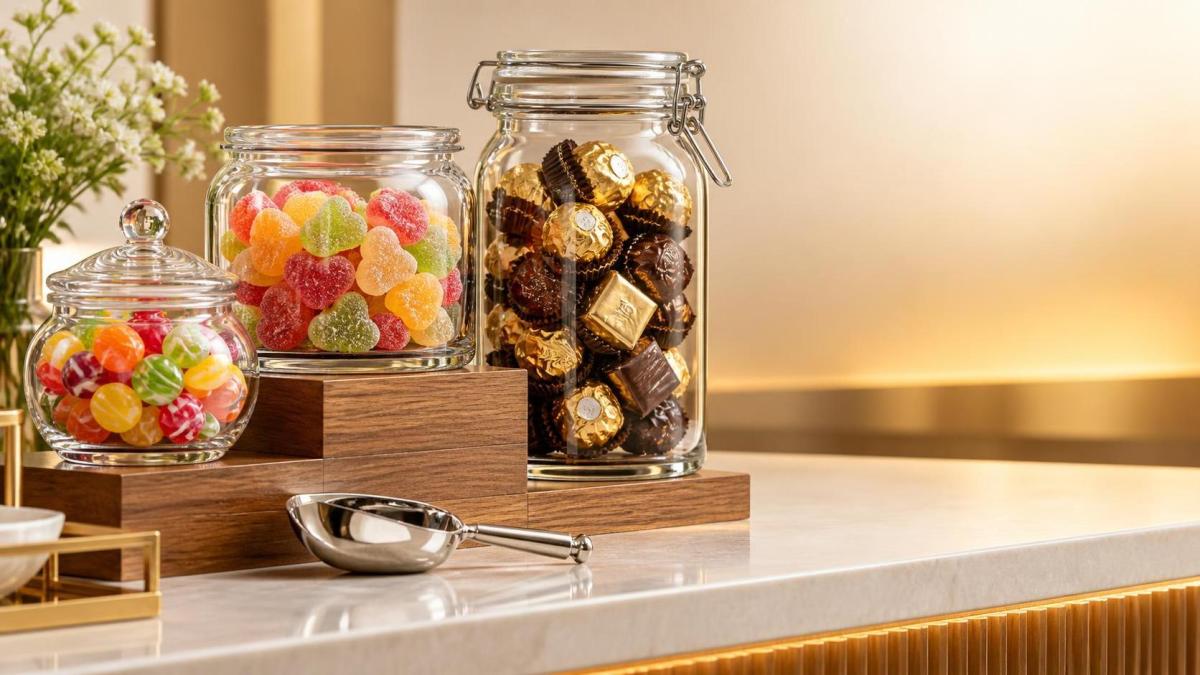
The lid is a functional choice, not a finishing touch
Lid style has a direct effect on hygiene, access speed, product condition, and the overall character of a display. The best lid depends on how frequently the jar is opened and how sensitive the contents are to air and moisture.
For loose candy, a lid should protect the product without making routine service cumbersome. A tightly sealed clamp lid may preserve texture well, but it can slow down a cashier who opens the jar dozens of times an hour. An open or partially covered format may support fast sales, yet it is less suitable for dusty environments, areas with heavy foot traffic, or products affected by humidity.
Do not assume every lid advertised as “airtight” performs equally. Ask suppliers how the closure is constructed, whether the sealing element is food-contact appropriate for the intended use, and whether replacement gaskets or lids can be purchased separately. Losing one lid should not make an otherwise usable jar obsolete.
Glass quality, shape, and durability deserve close inspection
Clear glass remains popular because it lets the product do the selling. Customers can see colors, textures, and fullness at a glance. In foodservice and retail environments, however, transparency also reveals fingerprints, candy dust, and uneven product levels. A display plan should account for the cleaning effort needed to keep glass looking inviting.
For regular commercial use, buyers should evaluate wall thickness, rim finish, base stability, and consistency across units. A heavy base can reduce the chance of tipping, particularly with tall jars or narrow counters. Smooth rims and rounded interior corners simplify washing and reduce places where sugar residue can collect. If jars will be handled frequently, consistent dimensions are valuable: lids, labels, shelving positions, and scoops can then be standardized.
Shape affects both merchandising and workflow:
- Cylinder jars use shelf space efficiently and provide a clean, modern presentation.
- Apothecary-style jars create a nostalgic or premium look, especially for boutique sweets and event displays.
- Square jars align neatly in rows and can reduce wasted shelf space, though corners may take more effort to clean.
- Wide, low jars improve access and work well for larger items such as cookies or wrapped chocolates.
- Tall jars create visual drama but need a stable base and may require longer scoops.
There is also a practical distinction between display glass and transport-ready storage. Even sturdy glass should not be treated as a carefree shipping container once filled. If operations require frequent movement between a central kitchen, retail branch, and event site, consider separate food-safe transport containers and use the glass candy jars primarily at the point of display.
Build the display around visibility, not just decoration
A candy display should help customers choose quickly while allowing staff to maintain order. The most successful arrangements often use variation in height and shape without sacrificing access. Tiered stands can add visual rhythm, but only if jars remain stable and easy to remove. Placing the tallest vessels at the back and lower, frequently accessed jars at the front usually creates a cleaner line of sight.
Color can guide placement. Bright, high-contrast candies attract attention, while neutral products such as caramels, nougat, or coated nuts benefit from clear labeling and thoughtful lighting. Avoid placing chocolate directly under strong warm lights or beside sunlit windows; a glass jar offers visibility, not thermal protection.
Procurement teams should consider the entire display system rather than buying jars one by one. Measure shelf depth, vertical clearance, counter load limits, and the room needed for opening lids. Confirm whether labels will be attached directly to the glass, displayed on shelf rails, or placed on small sign holders. In markets where allergen communication is required, make sure the chosen presentation leaves adequate room for product names and ingredient or allergen information.
Hygiene and cleaning: where attractive displays can fail
Glass is non-porous and generally easy to inspect visually, which makes it a practical material for food presentation. Still, jar hygiene depends on design and process. Narrow-neck jars can be difficult to reach. Decorative lids with deep grooves may hold dust. Gaskets require periodic removal and inspection, especially in humid settings where residue can develop.
During supplier evaluation, ask whether the jar and lid are suitable for the intended washing method. Commercial dishwashing compatibility, temperature limits, and handling guidance should be clarified before bulk purchasing. A dishwasher-safe jar may still have a lid component, printed decoration, or gasket that needs gentler care.
Operationally, establish a simple rotation routine: empty the jar when appropriate, clean and dry it fully, then refill it with properly rotated stock. Topping new candy onto older product may be tempting during a rush, but it makes product dating and cleanliness harder to manage. For self-service environments, dedicated scoops or tongs should be sized for the jar opening and positioned so handles remain outside the food area.
A practical sourcing checklist for buyers
When comparing glass candy jar suppliers, the unit price is only one part of the decision. The real cost includes breakage, replacement availability, cleaning time, compatibility with current displays, and the risk of receiving inconsistent items across repeat orders.
- Request exact dimensions, including opening diameter, lid height, and base width.
- Confirm stated capacity and consider testing it with the actual candy product.
- Check whether lids, seals, and individual jars can be reordered separately.
- Review packing methods for shipment, especially for large or thin-walled jars.
- Ask for samples before committing to a broad assortment or a large volume.
- Test the jar with the intended scoop, tong, label, shelf, and cleaning process.
- Plan a modest overage for breakage and for maintaining a consistent display during cleaning cycles.
For multi-location operations, standardization is often worth more than an unusually decorative design. Using a limited family of compatible jars can simplify training, replenishment, visual merchandising, and replacement purchasing. A flagship store may justify distinctive apothecary jars, while smaller sites benefit from durable, repeatable formats that staff can handle confidently.
Make the final choice with a sample display
The best way to assess a glass candy jar is to place it in a realistic setting. Fill it with the actual product, fit the intended lid, add the label, and ask staff to open, serve, refill, and clean it. View the display from a customer’s eye level as well as from behind the counter. What seems appealing in a catalog may look oversized on a shallow shelf, too small from a distance, or difficult to use during a busy shift.
A well-chosen glass candy jar supports the quiet details of a good food presentation: candy stays protected, the display feels generous rather than cluttered, staff work with less friction, and customers can see exactly what makes them pause. For procurement teams, that combination of durability, hygiene, capacity, and visual appeal is the real measure of a sound purchasing decision.
Popular Tags
Kitchen Industry Research Team
Dedicated to analyzing emerging trends and technological shifts in the global hospitality and foodservice infrastructure sector.
Industry Insights
Join 15,000+ industry professionals. Get the latest market trends and tech news delivered weekly.
No spam. Unsubscribe anytime.
Hot Articles
Contact With us
Contact:
Anne Yin (Ceramics Dinnerware/Glassware)
Lucky Zhai(Flatware)